
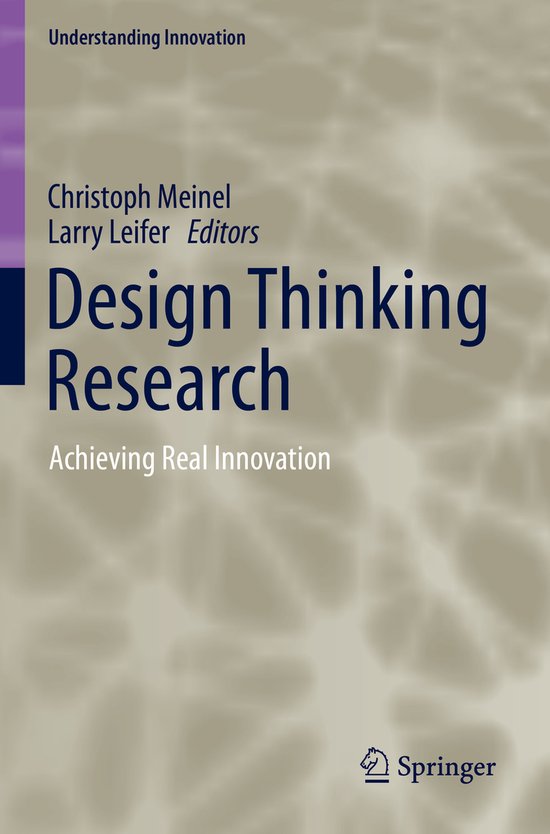
Understanding Innovation- Design Thinking Research
Christoph Meinel
- 09 september 2023
- 9783031092992
Samenvatting:
Extensive research conducted by the Hasso Plattner Design Thinking Research Program at Stanford University in Palo Alto, California, USA, and the Hasso Plattner Institute in Potsdam, Germany, has yielded valuable insights on why and how design thinking works.
An increasing number of individuals and institutions have come to recognize the innovative power of design thinking. However, its success story has also meant that the term has evolved into something of an overused, or even misused, buzzword. The demand for an in-depth, evidence-based understanding of the way design thinking works has grown accordingly. This challenge is addressed by the Hasso Plattner Design Thinking Research Program. Summarizing the outcomes of the research program’s 13th year, this book presents a broad range of scientific insights gained by researchers at the Hasso Plattner Institute in Potsdam, Germany and Stanford University in California, in the course of their investigations, experiments and studies.
Special focus is placed on the impact, accessibility and measurability of design thinking. The contributing authors seek to establish common ground, conduct modelling, and develop essential toolkits. The expanding field of neurodesign is also addressed in contributions that explore the neural basis for creativity and nonverbal actions. The results of this rigorous academic research are not meant to be discussed exclusively within the scientific community: they will hopefully find their way to those who seek to promote innovation through collaboration, be it at businesses or in society.Extensive research conducted by the Hasso Plattner Design Thinking Research Program at Stanford University in Palo Alto, California, USA, and the Hasso Plattner Institute in Potsdam, Germany, has yielded valuable insights on why and how design thinking works. The participating researchers have identified metrics, developed models, and conducted studies, which are featured in this book, and in the previous volumes of this series.
This volume provides readers with tools to bridge the gap between research and practice in design thinking with varied real world examples. Several different approaches to design thinking are presented in this volume. Acquired frameworks are leveraged to understand design thinking team dynamics. The contributing authors lead the reader through new approaches and application fields and show that design thinking can tap the potential of digital technologies in a human-centered way. It also presents new ideas in neurodesign from Stanford University andthe Hasso Plattner Institute in Potsdam, inviting the reader to consider newly developed methods and how these insights can be applied to different domains.
Design thinking can be learned. It has a methodology that can be observed across multiple settings and accordingly, the reader can adopt new frameworks to modify and update existing practice. The research outcomes compiled in this book are intended to inform and provide inspiration for all those seeking to drive innovation – be they experienced design thinkers or newcomers.