
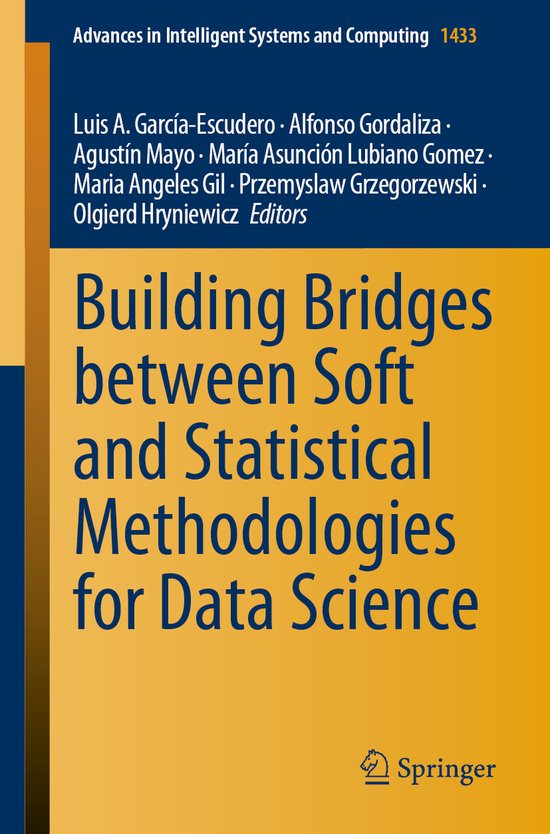
Advances in Intelligent Systems and Computing1433- Building ...
Luis A. García-Escudero
- 26 augustus 2022
- 9783031155086
Samenvatting:
Nowadays, data analysis is becoming an appealing topic due to the emergence of new data types, dimensions, and sources.
Nowadays, data analysis is becoming an appealing topic due to the emergence of new data types, dimensions, and sources. This motivates the development of probabilistic/statistical approaches and tools to cope with these data. Different communities of experts, namely statisticians, mathematicians, computer scientists, engineers, econometricians, and psychologists are more and more interested in facing this challenge. As a consequence, there is a clear need to build bridges between all these communities for Data Science.
This book contains more than fifty selected recent contributions aiming to establish the above referred bridges. These contributions address very different and relevant aspects such as imprecise probabilities, information theory, random sets and random fuzzy sets, belief functions, possibility theory, dependence modelling and copulas, clustering, depth concepts, dimensionality reduction of complex data and robustness.
Nowadays, data analysis is becoming an appealing topic due to the emergence of new data types, dimensions, and sources. This motivates the development of probabilistic/statistical approaches and tools to cope with these data. Different communities of experts, namely statisticians, mathematicians, computer scientists, engineers, econometricians, and psychologists are more and more interested in facing this challenge. As a consequence, there is a clear need to build bridges between all these communities for Data Science.
This book contains more than fifty selected recent contributions aiming to establish the above referred bridges. These contributions address very different and relevant aspects such as imprecise probabilities, information theory, random sets and random fuzzy sets, belief functions, possibility theory, dependence modelling and copulas, clustering, depth concepts, dimensionality reduction of complex data and robustness.