
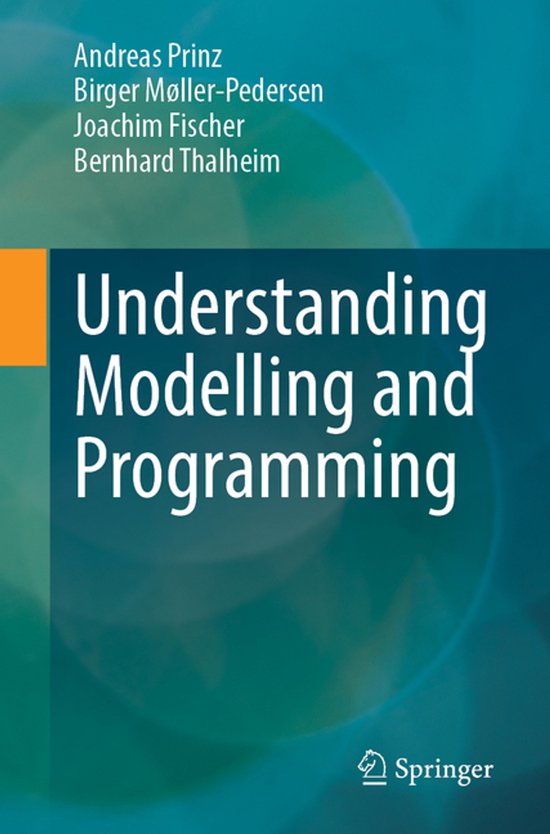
Understanding Modelling and Programming
Andreas Prinz
- 30 december 2024
- 9783031712791
Samenvatting:
This book provides a concise overview of modelling and programming by presenting their essential concepts. It enables the reader to better understand the relationships between modelling and programming by describing abstract properties, desired behaviours, intended structures, needed interactions, and other specific viewpoints on the overall system under development.
After an introduction to the importance of modelling and programming in the scope of system engineering in chapter 1, the book provides four main chapters covering systems, models, specifications, and programs, each of them with a set of reflection exercises. Chapter 2 explores how systems relate to reality, exploring different perspectives related to the purpose of the system. Chapter 3 explains what it takes to be a model and how models and systems are related and concludes with discussing model semantics, meaning, and correctness. In Chapter 4, specifications are debated which are precise descriptions of models and systems. It presents the language constructs needed to describe systems and shows how the constructs can be expressed in concrete languages, considering both the structure and the behaviour of models. Chapter 5 considers the creation, simulation, and correct execution of specifications (model descriptions or programs). Eventually, Chapter 6 presents a collection of real-world modelling cases. Apart from describing the case, the concepts of the book are applied to the case, thus giving a better understanding of the concepts.
The book is carefully designed to explain modelling and programming concepts, their relationships, and their use. Written for computer science students and lecturers, it covers systems, modelling, programming, simulation, and semantics.
This book provides a concise overview of modelling and programming by presenting their essential concepts. It enables the reader to better understand the relationships between modelling and programming by describing abstract properties, desired behaviours, intended structures, needed interactions, and other specific viewpoints on the overall system under development.
After an introduction to the importance of modelling and programming in the scope of system engineering in chapter 1, the book provides four main chapters covering systems, models, specifications, and programs, each of them with a set of reflection exercises. Chapter 2 explores how systems relate to reality, exploring different perspectives related to the purpose of the system. Chapter 3 explains what it takes to be a model and how models and systems are related and concludes with discussing model semantics, meaning, and correctness. In Chapter 4, specifications are debated which are precise descriptions of models and systems. It presents the language constructs needed to describe systems and shows how the constructs can be expressed in concrete languages, considering both the structure and the behaviour of models. Chapter 5 considers the creation, simulation, and correct execution of specifications (model descriptions or programs). Eventually, Chapter 6 presents a collection of real-world modelling cases. Apart from describing the case, the concepts of the book are applied to the case, thus giving a better understanding of the concepts.
The book is carefully designed to explain modelling and programming concepts, their relationships, and their use. Written for computer science students and lecturers, it covers systems, modelling, programming, simulation, and semantics.