
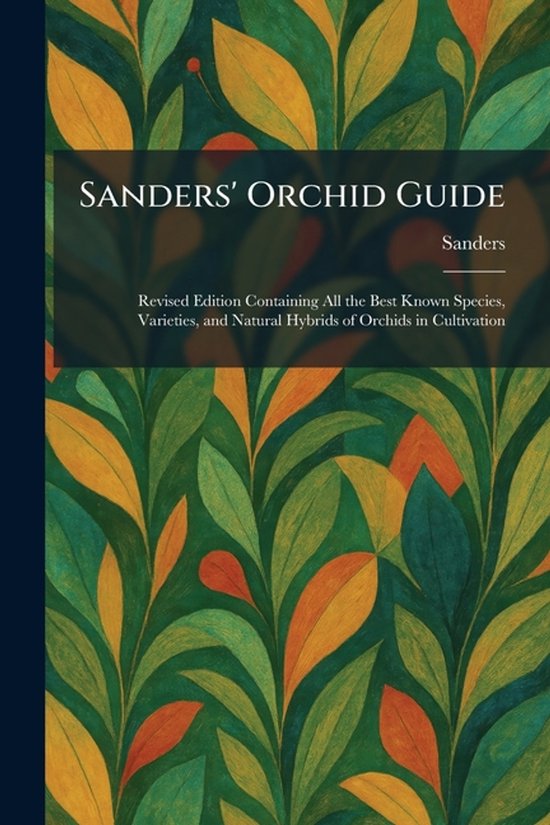
Sanders' Orchid Guide
- 14 februari 2026
- 9781025971339
Samenvatting:
"Sanders' Orchid Guide" is a comprehensive and authoritative reference dedicated to the identification, classification, and cultivation of one of the world's most diverse and captivating plant families. This revised edition provides detailed descriptions of the finest species, varieties, and natural hybrids known to be in cultivation, offering a systematic overview of the orchidaceous world. Designed to serve both professional botanists and dedicated horticulturalists, the work provides a rigorous look at the nomenclature and unique characteristics that define these exotic plants.
The text covers an extensive range of genera, documenting the morphological traits and growth habits of numerous orchid varieties. By cataloging both established species and the natural hybrids encountered by collectors and growers, the guide offers a meticulous snapshot of botanical diversity. Its clear, descriptive entries help the reader navigate the complexities of orchid taxonomy, making it a functional tool for specimen identification.As a foundational text in the field of orchidology, "Sanders' Orchid Guide" remains a valuable resource for anyone interested in the history of plant cultivation. Its emphasis on accuracy and breadth of scope ensures its status as a significant contribution to botanical literature, providing lasting insights into the beauty and variety of the orchid family for collectors, gardeners, and scientists alike.This work has been selected by scholars as being culturally important, and is part of the knowledge base of civilization as we know it. This work was reproduced from the original artifact, and remains as true to the original work as possible. Therefore, you may see the original copyright references, library stamps (as most of these works have been housed in our most important libraries around the world), and other notations in the work.This work is in the public domain in the United States of America, and possibly other nations. Within the United States, you may freely copy and distribute this work, as no entity (individual or corporate) has a copyright on the body of the work.As a reproduction of a historical artifact, this work may contain missing or blurred pages, poor pictures, errant marks, etc. Scholars believe, and we concur, that this work is important enough to be preserved, reproduced, and made generally available to the public. We appreciate your support of the preservation process, and thank you for being an important part of keeping this knowledge alive and relevant.