
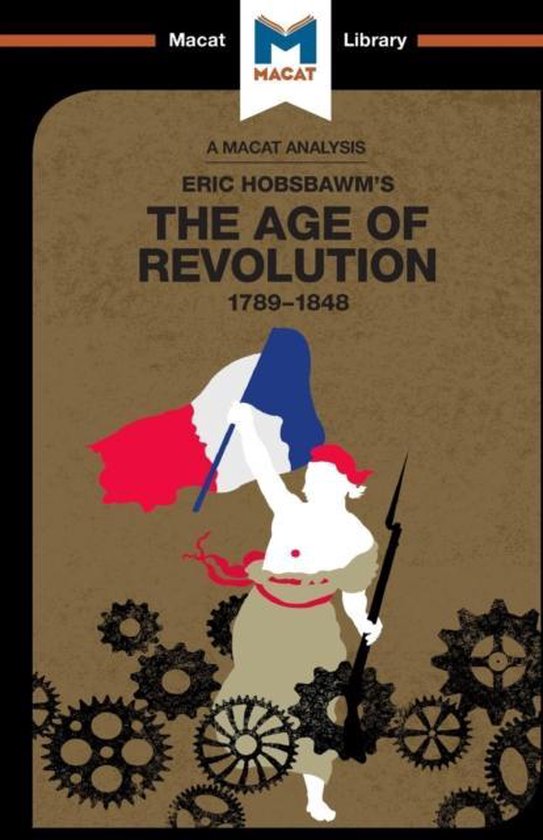
An Analysis of Eric Hobsbawm's The Age Of Revolution
Tom Stammers
- 05 juli 2017
- 9781912127658
Samenvatting:
In The Age of Revolution, Eric Hobsbawm focuses on the tumultuous late 18th and early 19th centuries. He argues that the “dual revolutions” of the time —the French Revolution and the British Industrial Revolution — changed the way the whole world thought about politics and power, and fundamentally shaped the modern era.
The Age of Revolution is the first of four works by Eric Hobsbawm that collectively synthesize the ideas he developed over a lifetime spent studying the nineteenth and twentieth centuries.
Hobsbawm's vision is important – he was a lifelong Marxist whose view of history was shaped by a fascination with social and economic history, yet who privileged evidence over political theory – but the real power of these works, and especially The Age of Revolution, emanates from the wide range of the author's reading and his mastery of the critical thinking skill of evaluation.
It is this skill that allows Hobsbawm to combine insights drawn from decades of reading into an original thesis that sees the crucial "long 19th century" as a period shaped by "dual revolution" – the twin impacts of the Industrial Revolution in Britain, and the French Revolution on the continent. Hobsbawm supplemented his evaluative excellence with a firm grasp of reasoning, crafting a volume that contains brilliant, clearly-structured arguments which explain complicated ideas via well-chosen examples in ways that make his work accessible to intelligent general readers and scholars alike.