
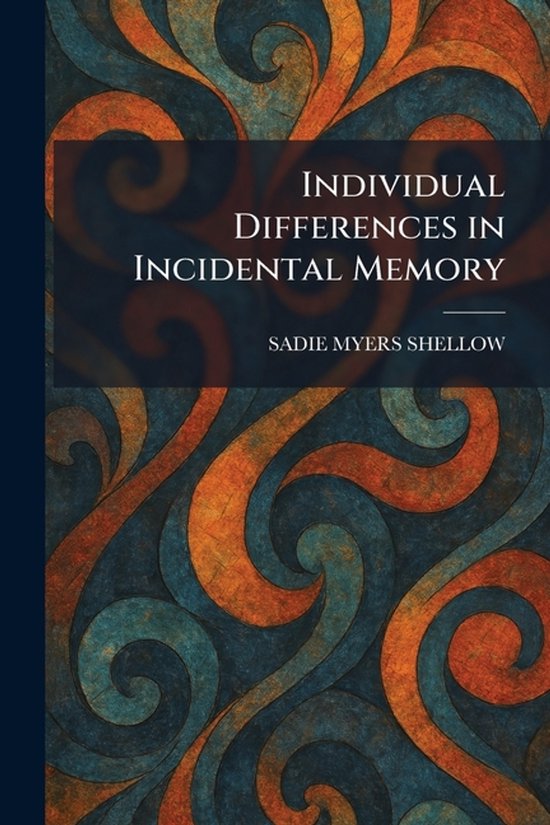
Individual Differences in Incidental Memory
Sadie Myers Shellow
- 14 februari 2026
- 9781025734088
Samenvatting:
"Individual Differences in Incidental Memory" is a specialized psychological study by Sadie Myers Shellow that explores the nuances of how individuals retain information without conscious effort. This work investigates the variability in memory performance when subjects are not intentionally trying to learn or memorize specific data. Through rigorous experimentation and data analysis typical of early 20th-century psychological research, Shellow examines the factors that contribute to these differences, offering insights into the mechanics of the human mind and the reliability of unintentional recall.The book serves as an important contribution to the field of cognitive psychology, particularly in the study of attention and perception. By analyzing how different people process and store incidental information, the author provides a foundation for understanding the complex interplay between environment, stimulus, and cognitive response. "Individual Differences in Incidental Memory" is a valuable resource for researchers, students, and anyone interested in the history of psychological testing and the evolution of memory studies.This work has been selected by scholars as being culturally important, and is part of the knowledge base of civilization as we know it. This work was reproduced from the original artifact, and remains as true to the original work as possible. Therefore, you may see the original copyright references, library stamps (as most of these works have been housed in our most important libraries around the world), and other notations in the work.This work is in the public domain in the United States of America, and possibly other nations. Within the United States, you may freely copy and distribute this work, as no entity (individual or corporate) has a copyright on the body of the work.As a reproduction of a historical artifact, this work may contain missing or blurred pages, poor pictures, errant marks, etc. Scholars believe, and we concur, that this work is important enough to be preserved, reproduced, and made generally available to the public. We appreciate your support of the preservation process, and thank you for being an important part of keeping this knowledge alive and relevant.