
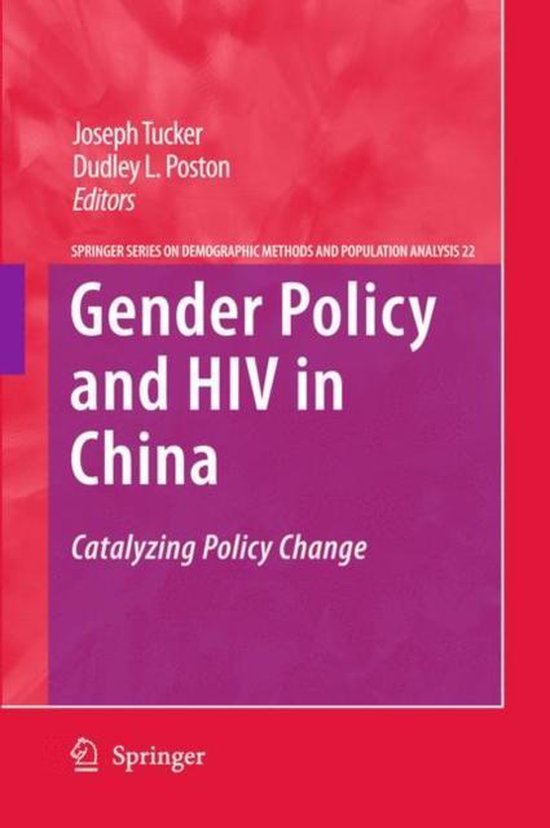
The Springer Series on Demographic Methods and Population An ...
Joseph Tucker
- 28 oktober 2010
- 9789048182190
Samenvatting:
China’s concentrated HIV epidemic is on the brink of becoming a generalized one and syphilis infection has become a major public health threat. A better understanding of the proximate social determinants of HIV related to gender will be crucial to effectively curbing HIV and other STIs in China.
China’s concentrated HIV epidemic is on the brink of becoming a generalized one and syphilis infection has become a major public health threat. Social factors relating to gender and gender inequality exacerbate the spread of HIV and sexually transmitted infections (STI) in China. A better understanding of the proximate social determinants of HIV related to gender will be crucial to effectively curbing HIV and other STIs in China. Aspects of China’s governance - including administrative procedures, the developing legal system, social institutions, and the public health infrastructure – are instrumental in shaping strategies and responses to HIV. International studies suggest that women who are more economically and socially vulnerable may also have a greater risk of HIV infection, yet few initiatives have focused on discrete areas where achievable and sustainable gender policy measures could be linked to the public health response. This study presents perspectives ranging from criminology to social psychology to better understand how gender perspectives can inform HIV policy in the context of China.
China’s concentrated HIV epidemic is on the brink of becoming a generalized one and syphilis infection has become a major public health threat. Social factors relating to gender and gender inequality exacerbate the spread of HIV and sexually transmitted infections (STI) in China. A better understanding of the proximate social determinants of HIV related to gender will be crucial to effectively curbing HIV and other STIs in China. Aspects of China’s governance - including administrative procedures, the developing legal system, social institutions, and the public health infrastructure – are instrumental in shaping strategies and responses to HIV. International studies suggest that women who are more economically and socially vulnerable may also have a greater risk of HIV infection, yet few initiatives have focused on discrete areas where achievable and sustainable gender policy measures could be linked to the public health response. This study presents perspectives ranging from criminology to social psychology to better understand how gender perspectives can inform HIV policy in the context of China.