
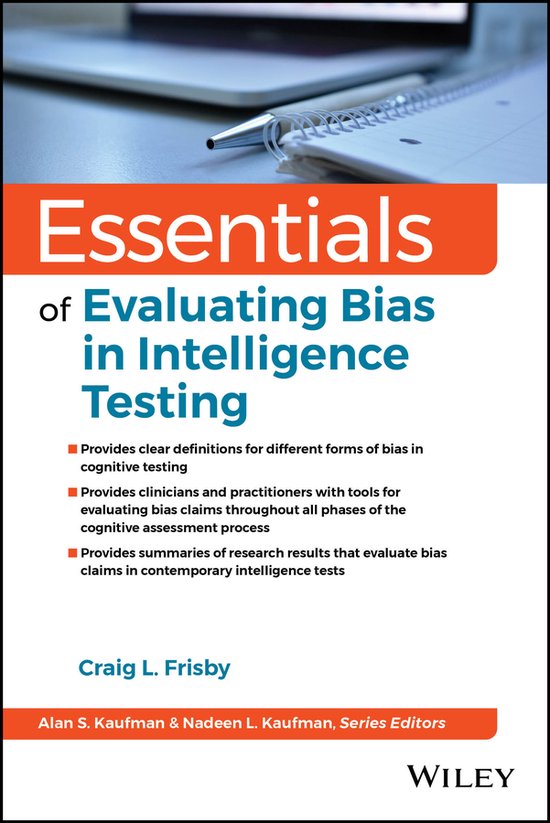
Essentials of Psychological Assessment- Essentials of Evalua ...
Craig L. Frisby
- 12 maart 2025
- 9781394184477
Samenvatting:
A thorough overview of the history and research findings concerning bias in intelligence testing
In Essentials of Evaluating Bias in Intelligence Testing, author and school psychologist Craig L. Frisby provides a comprehensive discussion of bias claims that have been levelled against individually administered IQ tests when used during the evaluation of clients in a variety of settings. The book carefully reviews bias claims in the selection, standardization, content, administration, scoring, and interpretation of popular individually administered intelligence tests in contemporary professional practice. The book reviews critical foundational concepts on what IQ test bias is, what it is not, and how researchers evaluate empirically any potential biases in commonly used measures.
Readers will also learn about the multifaceted construct of human intelligence, and what kinds of test items are good measures of intellectual functioning. In addition, the author provides key sociopolitical contexts to central issues in intelligence testing, particularly the Larry P. v. Wilson Riles court decision of 1979 - which prohibited the use of IQ tests when placing Black students in certain special education programs in the state of California.
The book is perfect for educators, academics, clinicians, and administrators seeking a comprehensive picture of individualized IQ testing, and its validity for responsible use across different demographic groups in the United States and abroad. Essentials of Evaluating Bias in Intelligence Testing is the must-read guide that clinicians, school/child psychologists, and educators have been waiting for.
Thorough overview of the history, viewpoints, and research findings of bias in intelligence testing
Essentials of Evaluating Bias in Intelligence Testing delivers a comprehensive overview of potential biases that can come to light when making use of IQ tests across demographics, detailing where bias can work its way into IQ test selection, standardization, content, administration/scoring, and interpretation and providing key foundational knowledge on what IQ test bias is versus what it is not as well as the history of bias claims in recent decades.
Research findings are included throughout the book to provide key context. Some of the topics discussed in this book include:
- The Larry P. v. Wilson Riles trial decision of 1979, which prohibited the use of IQ tests for placing Black students in special education programs, and its carryover to today
- The heritability of IQ scores, the “nature/nurture” issue, and the role of IQ in the stratification of subpopulation groups in society
- Implicit assumptions within claims of standardization bias, including that all population subgroups must display equal mean scores and that racial/ethnic groups are internally homogeneous
Essentials of Evaluating Bias in Intelligence Testing is an essential read for educators, academics, and administrators seeking to understand the full picture on IQ testing and its validity or lack thereof across different demographics.