
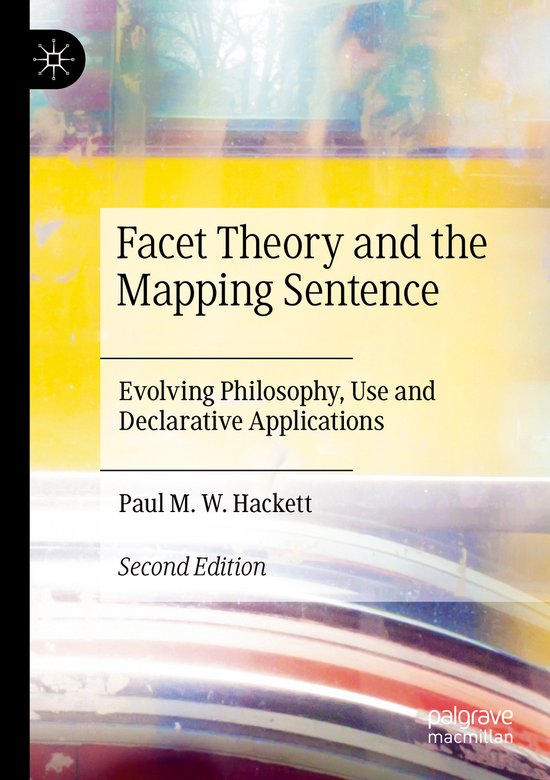
Facet Theory and the Mapping Sentence
Paul M.W. Hackett
- 24 maart 2022
- 9783030662011
Samenvatting:
This book is the second edition of Facet Theory and the Mapping Sentence: Evolving Philosophy, Use and Application (2014).
This book is the second edition of Facet Theory and the Mapping Sentence: Evolving Philosophy, Use and Application (2014). It consolidates the qualitative and quantitative research positions of facet theory and delves deeper into their qualitative application in psychology, social and the behavioural sciences and in the humanities. In their traditional quantitative guise, facet theory and its mapping sentence incorporate multi-dimensional statistics. They are also a way of thinking systematically and thoroughly about the world.
The book is particularly concerned with the development of the declarative mapping sentence as a tool and an approach to qualitative research. The evolution of the facet theory approach is presented along with many examples of its use in a wide variety of research domains. Since the first edition, the major advance in facet theory has been the formalization of the use of the declarative mapping sentence and this is given a prominent position in the new edition. The book will be compelling reading for students at all levels and for academics and research professionals from the humanities, social sciences and behavioural sciences.
Paul M.W. Hackett is a professor at the University of Suffolk, UK and has published widely on facet theory in books and articles. He has PhDs in psychology and in art and has held academic positions at Durham, Cambridge, Oxford and Birmingham in the UK and at Tufts Universities and Emerson College in the US. Hackett developed the declarative mapping sentence as an approach to qualitative and philosophically oriented research.
This book is the second edition of Facet Theory and the Mapping Sentence: Evolving Philosophy, Use and Application (2014). It consolidates the qualitative and quantitative research positions of facet theory and delves deeper into their qualitative application in psychology, social and the behavioural sciences and in the humanities. In their traditional quantitative guise, facet theory and its mapping sentence incorporate multi-dimensional statistics. They are also a way of thinking systematically and thoroughly about the world.
The book is particularly concerned with the development of the declarative mapping sentence as a tool and an approach to qualitative research. The evolution of the facet theory approach is presented along with many examples of its use in a wide variety of research domains. Since the first edition, the major advance in facet theory has been the formalization of the use of the declarative mapping sentenceand this is given a prominent position in the new edition. The book will be compelling reading for students at all levels and for academics and research professionals from the humanities, social sciences and behavioural sciences.