
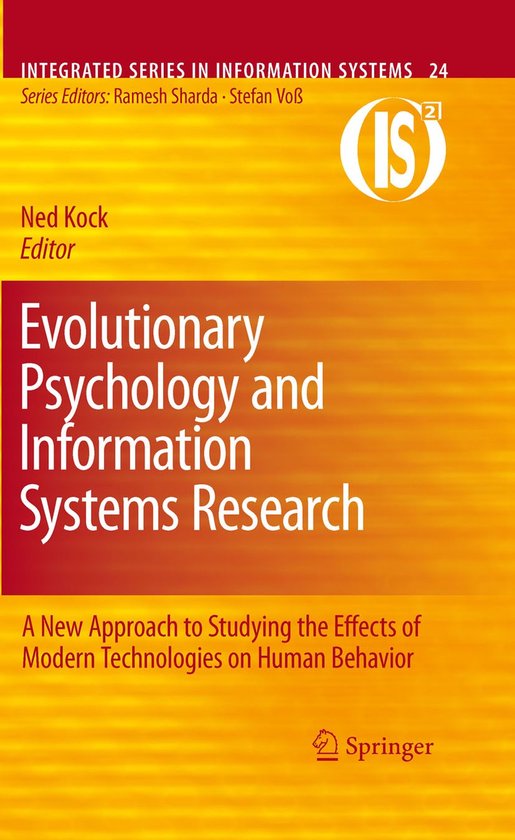
Evolutionary Psychology and Information Systems Research
Ned Kock
- 19 augustus 2010
- 9781441961389
Samenvatting:
The main goal of this book is to serve as a reference for IS research building on EP concepts and theories (in short, IS-EP research). The book is organized in three main parts: Part I focuses on EP concepts and theories that can be used as a basis for IS-EP research;
Evolutionary Psychology and Information Systems Research: A New Approach to Studying the Effects of Modern Technologies on Human Behavior is a compilation of chapters written by leading researchers from all over the world. Those researchers’ common characteristic is that they have investigated issues at the intersection of the fields of information systems (IS) and evolutionary psychology (EP). The main goal of this book is to serve as a reference for IS research building on EP concepts and theories (in short, IS-EP research). The book is organized in three main parts: Part I focuses on EP concepts and theories that can be used as a basis for IS-EP research; Part II provides several exemplars of IS-EP research in practice; and Part III summarizes emerging issues and debate that can inform IS-EP research, including debate regarding philosophical foundations and credibility of related findings. EP has the potential to become one of the pillars on which IS research can take place. The explanatory power of EP comes from the fact that its underlying ideas relate to the basic design of our brain (and, more generally, our body; including endocrine glands that strongly influence our brain processes and our behavior), and thus can form the basis on which fundamental explanations of behavior in the context of IS design and use can be developed. EP also arguably holds the key to many counterintuitive explanations of behavior toward modern technologies, because many of the evolved instincts that influence our behavior are below the level of our conscious awareness. Often those instincts lead to behavioral responses whose motivations and patterns are not self-evident to the individuals involved – e.g., the fact that we tend to develop vivid memories of facts surrounding a surprising event, whether that event occurs in a real or technology-created (virtual) environment. Integrated Series in Information Systems (IS²) strives to publish scholarly work in the technical aswell as the organizational side of the field. This series contains three sub-series including: expository and research monographs, integrative handbooks, and edited volumes, focusing on the state-of-the-art of application domains and/or reference disciplines, as related to information systems.
This book is a compilation of chapters written by leading researchers from all over the world. Those researchers’ common characteristic is that they have investigated issues at the intersection of the elds of information systems (IS) and evoluti- ary psychology (EP). The main goal of this book is to serve as a reference for IS research building on EP concepts and theories (in short, IS-EP research). The book is organized in three main parts: Part I focuses on EP concepts and theories that can be used as a basis for IS-EP research; Part II provides several exemplars of IS-EP research in practice; and Part III summarizes emerging issues and debate that can inform IS-EP research, including debate regarding philosophical foundations and credibility of related ndings. IS-EP research is generally concerned with the use of concepts and theories from EP in the study of IS, particularly regarding the impact of modern information and communication technologies on the behavior of individuals, groups, and organi- tions. From a practitioners’ perspective, the most immediate consumers of IS-EP research are those who develop and use IS, of which a large contingent are in bu- nesses that employ IS to support marketing, order-taking, production, and delivery of goods and services. In this context, IS-EP ndings may be particularly useful due to the present need to design web-based interfaces that will be used by in- viduals from different cultures, and often different countries, and whose common denominator is their human nature.