
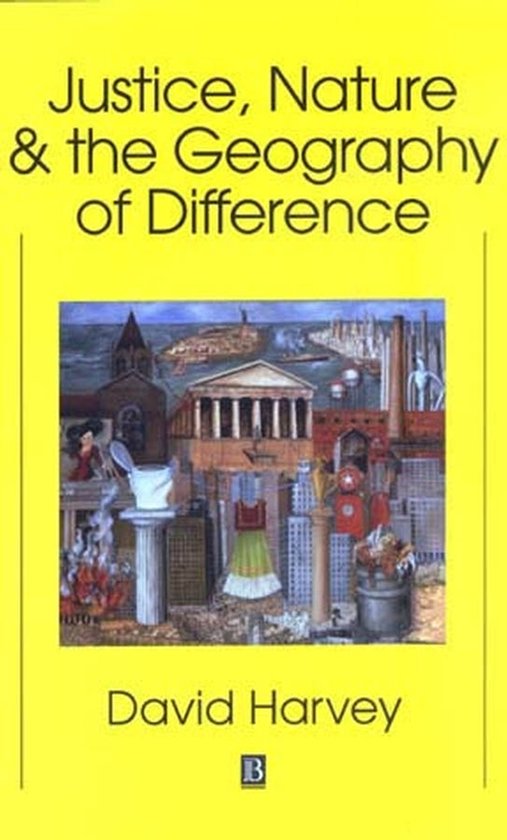
Justice, Nature and the Geography of Difference
David Harvey
- 07 december 1996
- 9781557866813
Samenvatting:
* The world's leading geographer establishes new foundations for the understanding of social life at different times and different places. * Reintroduces concepts of value into postmodern social theory.
This book engages with the politics of social and environmental justice, and seeks new ways to think about the future of urbanization in the twenty-first century. It establishes foundational concepts for understanding how space, time, place and nature - the material frames of daily life - are constituted and represented through social practices, not as separate elements but in relation to each other. It describes how geographical differences are produced, and shows how they then become fundamental to the exploration of political, economic and ecological alternatives to contemporary life.
The book is divided into four parts. Part I describes the problematic nature of action and analysis at different scales of time and space, and introduces the reader to the modes of dialectical thinking and discourse which are used throughout the remainder of the work. Part II examines how "nature" and "environment" have been understood and valued in relation to processes of social change and seeks, from this basis, to make sense of contemporary environmental issues.
Part III, is a wide-ranging discussion of history, geography and culture, explores the meaning of the social "production" of space and time, and clarifies problems related to "otherness" and "difference". The final part of the book deploys the foundational arguments the author has established to consider contemporary problems of social justice that have resulted from recent changes in geographical divisions of labor, in the environment, and in the pace and quality of urbanization.
Justice, Nature and the Geography of Difference speaks to a wide readership of students of social, cultural and spatial theory and of the dynamics of contemporary life. It is a convincing demonstration that it is both possible and necessary to value difference and to seek a just social order.
This book engages with the politics of social and environmental justice, and seeks new ways to think about the future of urbanization in the twenty-first century. It establishes foundational concepts for understanding how space, time, place and nature - the material frames of daily life - are constituted and represented through social practices, not as separate elements but in relation to each other. It describes how geographical differences are produced, and shows how they then become fundamental to the exploration of political, economic and ecological alternatives to contemporary life.
The book is divided into four parts. Part I describes the problematic nature of action and analysis at different scales of time and space, and introduces the reader to the modes of dialectical thinking and discourse which are used throughout the remainder of the work. Part II examines how "nature" and "environment" have been understood and valued in relation to processes of social change and seeks, from this basis, to make sense of contemporary environmental issues.
Part III, is a wide-ranging discussion of history, geography and culture, explores the meaning of the social "production" of space and time, and clarifies problems related to "otherness" and "difference". The final part of the book deploys the foundational arguments the author has established to consider contemporary problems of social justice that have resulted from recent changes in geographical divisions of labor, in the environment, and in the pace and quality of urbanization.
Justice, Nature and the Geography of Difference speaks to a wide readership of students of social, cultural and spatial theory and of the dynamics of contemporary life. It is a convincing demonstration that it is both possible and necessary to value difference and to seek a just social order.