
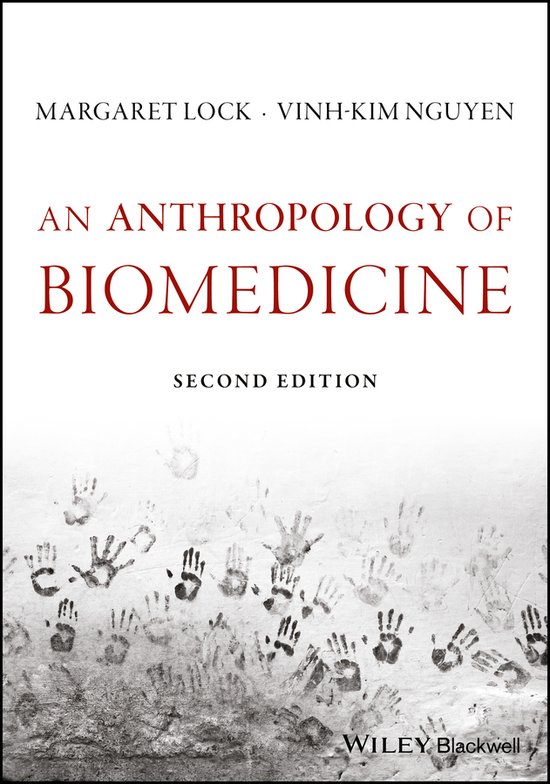
An Anthropology of Biomedicine
Margaret M. Lock
- 23 februari 2018
- 9781119069133
Samenvatting:
"This profoundly revised version of a book that has already become a classic incorporates the most recent developments and challenges in medicine, biology and public health as well as the most salient questions and debates among anthropologists studying these various fields. Addressing issues at the interface between physical life and social life, it brilliantly covers a broad domain from biomedical technologies to global health."
Didier Fassin, Institute for Advanced Study, Princeton and École des Hautes Études en Sciences Sociales, Paris, France
"This second edition of An Anthropology of Biomedicine moves at the speed of the global reach of the subject it analyzes: persuasively argued and richly illustrated with ethnographic, historical, sociomedical and legal cases, this book offers the exemplary and synthetic discussion of biomedicine as a sociotechnical system. Lock and Nguyen's persuasive volume is now thoroughly updated and contains new chapters on microbiology and the microbiome; global health; and, the self as a socio-technical system, making it a challenging and key text for the wide array of fields in which the social sciences intersect with all aspects of the production of and inequalities in health."
Rayna Rapp, Professor of Anthropology, New York University, USA
In this fully revised and updated second edition of An Anthropology of Biomedicine, authors Lock and Nguyen introduce biomedicine from an anthropological perspective, exploring the entanglement of material bodies with history, environment, culture, and politics. Drawing on historical and ethnographic work, the book critiques the assumption made by the biological sciences of a universal human body that can be uniformly standardized. It focuses on the ways in which the application of biomedical technologies brings about radical changes to societies at large based on socioeconomic inequalities and ethical disputes, and develops and integrates the theory that the human body in health and illness is not an ontological given but a moveable, malleable entity.
This second edition includes new chapters on: microbiology and the microbiome; global health; and, the self as a socio-technical system. In addition, all chapters have been comprehensively revised to take account of developments from within this fast-paced field, in the intervening years between publications. References and figures have also been updated throughout.
This highly-regarded and award-winning textbook (Winner of the 2010 Prose Award for Archaeology and Anthropology) retains the character and features of the previous edition. Its coverage remains broad, including discussion of: biomedical technologies in practice; anthropologies of medicine; biology and human experiments; infertility and assisted reproduction; genomics, epigenomics, and uncertain futures; and molecularizing racial difference, ensuring it remains the essential text for students of anthropology, medical anthropology as well as public and global health.
In this fully revised and updated second edition of An Anthropology of Biomedicine, authors Lock and Nguyen introduce biomedicine from an anthropological perspective, exploring the entanglement of material bodies with history, environment, culture, and politics. Drawing on historical and ethnographic work, the book critiques the assumption made by the biological sciences of a universal human body that can be uniformly standardized. It focuses on the ways in which the application of biomedical technologies brings about radical changes to societies at large based on socioeconomic inequalities and ethical disputes, and develops and integrates the theory that the human body in health and illness is not an ontological given but a moveable, malleable entity.
This second edition includes new chapters on: microbiology and the microbiome; global health; and, the self as a socio-technical system. In addition, all chapters have been comprehensively revised to take account of developments from within this fast-paced field, in the intervening years between publications. References and figures have also been updated throughout.
This highly-regarded and award-winning textbook (Winner of the 2010 Prose Award for Archaeology and Anthropology) retains the character and features of the previous edition. Its coverage remains broad, including discussion of: biomedical technologies in practice; anthropologies of medicine; biology and human experiments; infertility and assisted reproduction; genomics, epigenomics, and uncertain futures; and molecularizing racial difference, ensuring it remains the essential text for students of anthropology, medical anthropology as well as public and global health.