
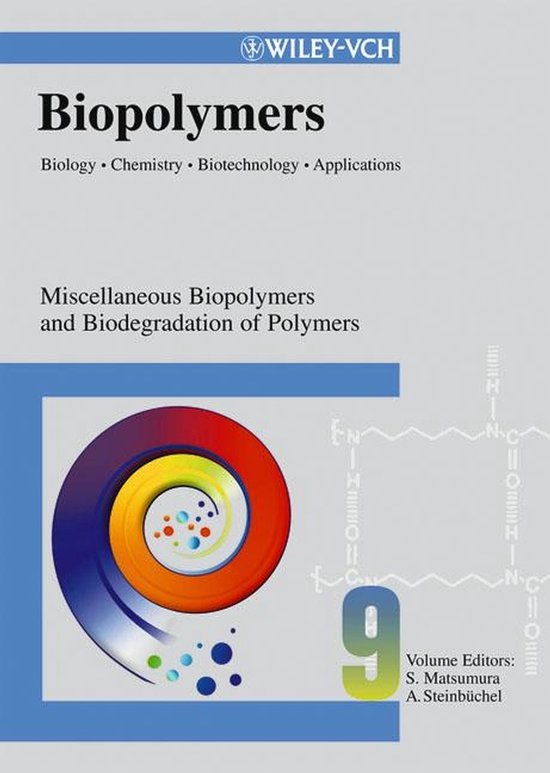
Biopolymers 9
Shuichi Matsumura
- 26 november 2002
- 9783527302284
Samenvatting:
Biopolymers represent the most abundant organic compounds in the biosphere and constitute the largest fraction of cells. Seven main classes of biopolymers are distinguished according to their chemical structures. This encyclopedia provides an overview of the occurrence and metabolism of biopolymers.
Bipolymers represent the most abundant organic compounds in the biosphere and constitute the largest fraction of cells. Seven main classes of biopolymers are distinguished according to their chemical structures. This encyclopedia provides a thorough overview of the occurence and metabolism of biopolymers. In addition, processes for biotechnological production, isolation from organisms and modification, material properties and technical applications in various areas, for example, daily life products, medicine, pharmacy, food industry, agriculture, textiles, chemical industry and packaging industry are provided. In addition, the future perspectives of biopolymers are outlined.
In its first part Volume 9 focusses on the biosynthesis, metabolism, biodegradation, functions, properties and applications of miscellaneous polymers such as:
- Inorganic Polyphosphates
- Sulfur-Containing Biopolymers
- Polyketides
- Natural Polyacetals
- Hemozoin and
- Thymine-Containing Styrene Polymers
The Second part opens with chapters on the biodegradation of
- Polysaccharides and
- Cellulose Accetate and Lignocellulose Plastics
The majority of chapters in part two cover the biodegradability and biodegradation of various synthetic polymers such as
- Polyethers
- Polyacrylate
- Polyurethanes
- Poly(vinyl Alcohol) and its copolymers
- Polystyrene
- Polyethylene and Derivatives
- Polycarbonates
- Polyanhydrides
- Poly(alkylcyano-acrylates_
- Polyphosphazenes
- Polydioxane
- and Silicones
The first part of this volume focuses on biosynthesis, metabolism, biodegradation, functions, properties and applications of miscellaneous polymers, such as hemozoin, thymine - containing styrene polymers, polythioesters, polyphosphate, polyhydroxymethionine, polyketides, and natural polyacetals. The second part then goes on to treat the biodegradation of a wide range of synthetic polymers, e.g. substituted cellulose nylon polycarbonate polyvinyl alcohol polyurethanes polystyrenes polyethylene polyanhydrides.