
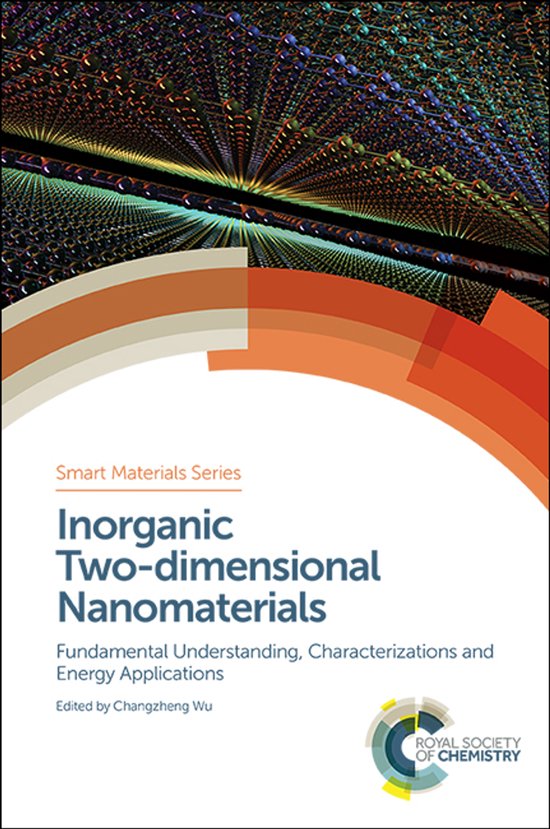
Inorganic Two-dimensional Nanomaterials
Changzheng Wu
- 24 augustus 2017
- 9781782624653
Samenvatting:
Inorganic Two-Dimensional Nanomaterials provides an overview of the development on inorganic two-dimensional nanomaterials from computational simulation and theoretical understanding to applications in energy conversion and storage.
Inorganic 2D nanomaterials, or inorganic graphene analogues, are gaining great attention due to their unique properties and potential energy applications. They contain ultrathin nanosheet morphology with one-dimensional confinement, but unlike pure carbon graphene, inorganic two-dimensional nanomaterials have a more abundant elemental composition and can form different crystallographic structures. These properties contribute to their unique chemical reaction activity, tunable physical properties and facilitate applications in the field of energy conversion and storage. Inorganic Two-dimensional Nanomaterials details the development of the nanostructures from computational simulation and theoretical understanding to their synthesis and characterization. Individual chapters then cover different applications of the materials as electrocatalysts, flexible supercapicitors, flexible lithium ion batteries and thermoelectrical devices. The book provides a comprehensive overview of the field for researchers working in the areas of materials chemistry, physics, energy and catalysis.
Inorganic 2D nanomaterials, or inorganic graphene analogues, are gaining great attention due to their unique properties and potential energy applications. They contain ultrathin nanosheet morphology with one-dimensional confinement, but unlike pure carbon graphene, inorganic two-dimensional nanomaterials have a more abundant elemental composition and can form different crystallographic structures. These properties contribute to their unique chemical reaction activity, tunable physical properties and facilitate applications in the field of energy conversion and storage.
Inorganic Two-dimensional Nanomaterials details the development of the nanostructures from computational simulation and theoretical understanding to their synthesis and characterization. Individual chapters then cover different applications of the materials as electrocatalysts, flexible supercapicitors, flexible lithium ion batteries and thermoelectrical devices.
The book provides a comprehensive overview of the field for researchers working in the areas of materials chemistry, physics, energy and catalysis.