
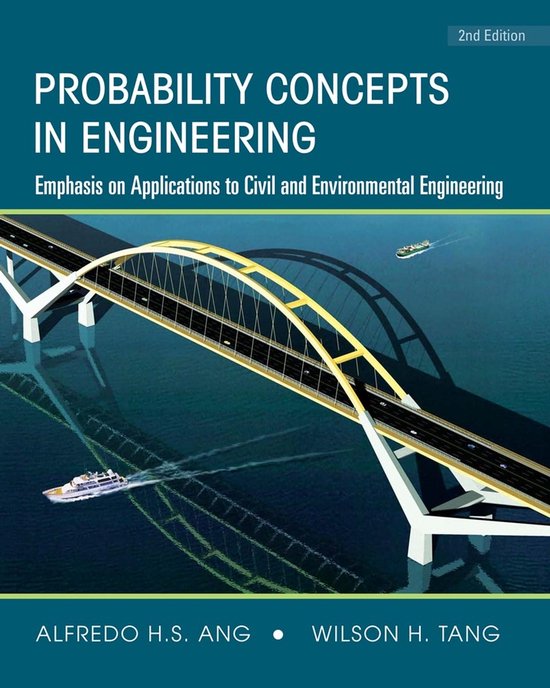
Probability Concepts in Engineering
Alfredo H-S. Ang
- 24 maart 2006
- 9780471720645
Samenvatting:
Thoroughly revised and updated, this second edition provides the basics of probability and statistical concepts in terms that are easily understood by engineers and engineering students. The basic principles are presented and illustrated through relevant problems to engineering and the physical sciences.
Apply the principles of probability and statistics to realistic engineering problems
The easiest and most effective way to learn the principles of probabilistic modeling and statistical inference is to apply those principles to a variety of applications. That’s why Ang and Tang’s Second Edition of Probability Concepts in Engineering (previously titled Probability Concepts in Engineering Planning and Design) explains concepts and methods using a wide range of problems related to engineering and the physical sciences, particularly civil and environmental engineering.
Now extensively revised with new illustrative problems and new and expanded topics, this Second Edition will help you develop a thorough understanding of probability and statistics and the ability to formulate and solve real-world problems in engineering. The authors present each basic principle using different examples, and give you the opportunity to enhance your understanding with practice problems. The text is ideally suited for students, as well as those wishing to learn and apply the principles and tools of statistics and probability through self-study.
Key Features in this 2nd Edition:
- A new chapter (Chapter 5) covers Computer-Based Numerical and Simulation Methods in Probability, to extend and expand the analytical methods to more complex engineering problems.
- New and expanded coverage includes distribution of extreme values (Chapter 3), the Anderson-Darling method for goodness-of-fit test (Chapter 6), hypothesis testing (Chapter 6), the determination of confidence intervals in linear regression (Chapter 8), and Bayesian regression and correlation analyses (Chapter 9).
- Many new exercise problems in each chapter help you develop a working knowledge of concepts and methods.
- Provides a wide variety of examples, including many new to this edition, to help you learn and understand specific concepts.
- Illustrates the formulation and solution of engineering-type probabilistic problems through computer-based methods, including developing computer codes using commercial software such as MATLAB and MATHCAD.
- Introduces and develops analytical probabilistic models and shows how to formulate engineering problems under uncertainty, and provides the fundamentals for quantitative risk assessment.
Apply the principles of probability and statistics to realistic engineering problems
The material in the book is intended for a first course on applied probability and statistics for engineering students at the sophomore or junior level, or for self study, stressing probabilistic modeling and the fundamentals of statistical inferences. The primary aim is to provide an in-depth understanding of the fundamentals for the proper application in engineering problems.
The second edition of this well-known book (previously titled Probability Concepts in Engineering Planning and Design) by Alfredo Ang and Wilson Tang, two world-renowned educators, has been revised to simplify understanding the fundamentals of probability and statistics for engineering students. The second edition includes many new and expanded topics, including hypothesis testing and confidence intervals in regression analysis. Students using this text will develop the ability to formulate and solve real-world problems in engineering. The authors accomplish this by explaining all the concepts and methods through a variety of relevant engineering and physical problems.
Each basic principle is presented and illustrated through different examples relevant to engineering and the physical sciences, particularly civil and environmental engineering. The exercise problems in each chapter further enhance understanding of basic concepts and reinforce a working knowledge of concepts and methods. The authors firmly believe that the easiest and most effective way for engineers to learn and master a new set of abstract principles is to apply them to a variety of applications.