
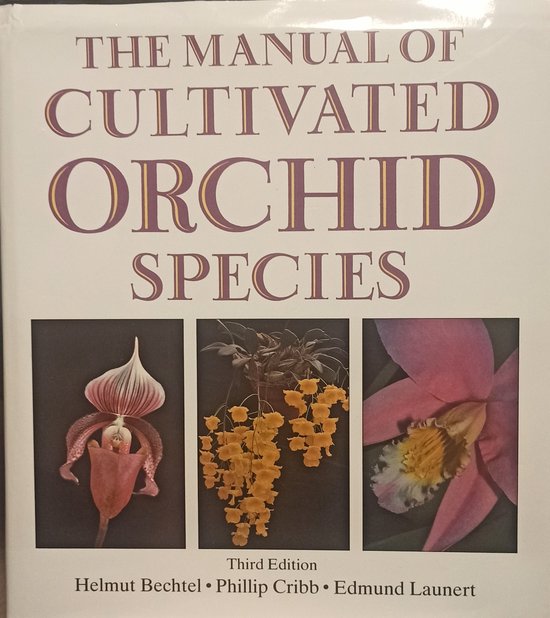
Tehe manual of cultivated Orchid Specied
Helmut Bechtel
- 9780713721041
Samenvatting:
Orchids are quite unlike other plants. Their exotic and delicate beauty has lured the adventurous cultivator for over a century, and yet they belong to one of the largest families of flowering plants and are found in almost all regions of the world.
The second revised edition of this book, which took account of the 1981 Dressler classification system, has now been further revised and expanded into a massive and authoritative volume. It is a comprehensive identification and cultivation guide, and represents the result of years of painstaking research and development. The Manual of Cultivated Orchid Species is recognised as the foremost handbook for orchid growers throughout the world.
A general introduction containing details of morphology, ecology, life histories, classification, nomenclature, conservation and a fascinating history of the orchid in cultivation, is followed by a detailed analysis of nearly 400 genera found in cultivation. For each genus distinguishing features are given, plus native location, a history of its taxonomy, derivations of name, and notes of its requirements in cultivation.
Under each genus a list of species most suitable for greenhouse cultivation is given — over 1200 in total. Each species is described in detail, the information including diagnostic features, distribution in the wild, other closely related species, and the synonyms under which the species may be known.
The text is accompanied by a unique and exciting collection of over 860 full colour photographs. These are based upon the work of Helmut Bechtel, the renowned German natural history photographer — who has travelled to the far corners of the world to capture these plants on film — and from important collections elsewhere.
Phillip Cribb is the Curator of the Orchid Herbarium at the Royal Botanic Gardens, Kew. Dr Edmund Launert, previously the Principal Scientific Officer at Kew, has now retired and works as a freelance consultant.
The popularity of orchid growing as a hobby has steadily increased since Victorian times despite temporary setbacks brought about by the two World Wars. The heyday of the cultivation of orchid species was undoubtedly in the latter half of the last century whilst, in this century, we have seen the introduction of tens of thousands of orchid hybrids, and the apparently unlimited variety of new forms and colours available has ensured their continuing popularity. However, the species which, as can be seen here, exhibit an incredible range of variability in shape, colour and size have continued to attract admirers amongst orchid growers. In the last twenty years or so a resurgence of mterest in the species has occurred and most collections now have at least a few pans or pots of them.
Many thousands of species have been or are stll in cultivation and more continue to be introduced each year. The sheer number of species involved has meant that identification has always been a great problem. Competent floristic accounts exist for the orchids of some areas of the world such as Peru, Thailand, West Africa and Brazil but these are often expensive and rare or even unobtainable works. Other areas rich in orchids, such as Colombia and New Guinea, lack comprehensive floristic accounts and yet large numbers of their species
The popularity of orchid growing as a hobby has steadily increased since Victorian times despite temporary setbacks brought about by the two World Wars. The heyday of the cultivation of orchid species was undoubtedly in the latter half of the last century whilst, in this century, we have seen the introduction of tens of thousands of orchid hybrids, and the apparently unlimited variety of new forms and colours available has ensured their continuing popularity. However, the species which, as can be seen here, exhibit an incredible range of variability in shape, colour and size have continued to attract admirers amongst orchid growers. In the last twenty years or so a resurgence of