
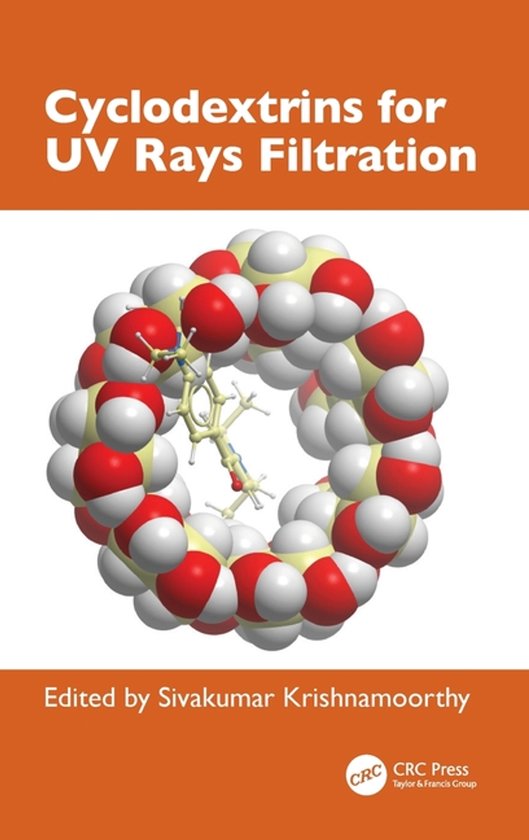
Cyclodextrins for UV Rays Filtration
Sivakumar Krishnamoorthy
- 29 september 2025
- 9781032795669
Samenvatting:
Traditional UVR absorbers pose environmental and health risks due to their volatility, solubility, and toxicity. High concentrations are needed for effective UV filtration, leading to environmental accumulation. Safer alternatives, like cyclodextrin complexation, can enhance UV filtration while reducing absorber concentration.
Traditional UVR absorbers pose environmental and health risks due to their volatility, solubility, and toxicity. High concentrations are needed for effective UV filtration, leading to environmental accumulation. Safer alternatives, like cyclodextrin complexation, can enhance UV filtration while reducing absorber concentration. Cyclodextrin complexation offers a promising solution by enhancing UV filtration efficiency while reducing the required concentration of UVR absorbers.
Cyclodextrins for UV Rays Filtration addresses a critical gap in photoprotection research by offering a comprehensive exploration of how cyclodextrins enhance UVR filtration. It provides an in-depth understanding of various UVR filters, including organic, inorganic, nanoparticle-based, natural, and herbal filters, while focusing on optimizing their efficiency through cyclodextrin complexation. This book serves as a single-point reference for researchers and professionals, guiding them in selecting suitable cyclodextrins based on UV absorber size, improving SPF/UPF performance, and reducing environmental impact. By presenting both fundamental principles and advanced applications, this book distinguishes itself as the first dedicated monograph on cyclodextrin-based UVR filters, making it an essential resource for academia and industry.
Features:
- Systematic overview of cyclodextrin-based UVR filtration principles, mechanisms, and methods.
- Insights from experts on advancements and future prospects of cyclodextrin-based UVR filters.
- Applications of cyclodextrins in sunscreens, lotions, textiles, protective films, and glass.
- Guidance on selecting and utilizing cyclodextrins for enhanced UVR protection.
- Coverage of both fundamental concepts and real-world uses of cyclodextrins in UVR filtration.
This book serves as a comprehensive and authoritative reference that will significantly benefit researchers, formulators, and professionals aiming to develop safer and more efficient photoprotective materials.