
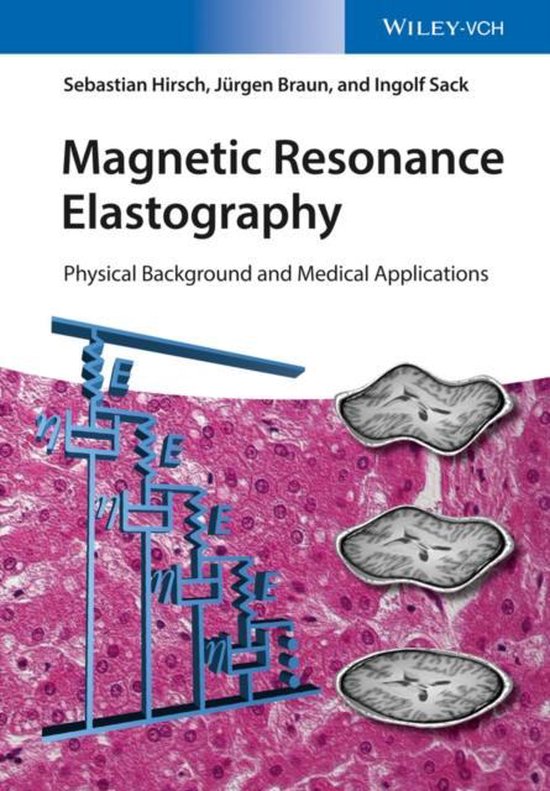
Magnetic Resonance Elastography
Sebastian Hirsch
- 11 januari 2017
- 9783527340088
Samenvatting:
This reference gives a sound introduction to the theoretical background of magnetic resonance elastography (MRE), covering both principles of magnetic resonanace imaging and (tissue) mechanics. Numerous clinical applications underline the capability of this exciting technology.
Magnetic resonance elastography (MRE) is a medical imaging technique that combines magnetic resonance imaging (MRI) with mechanical vibrations to generate maps of viscoelastic properties of biological tissue. It serves as a non-invasive tool to detect and quantify mechanical changes in tissue structure, which can be symptoms or causes of various diseases. Clinical and research applications of MRE include staging of liver fibrosis, assessment of tumor stiffness and investigation of neurodegenerative diseases.
The first part of this book is dedicated to the physical and technological principles underlying MRE, with an introduction to MRI physics, viscoelasticity theory and classical waves, as well as vibration generation, image acquisition and viscoelastic parameter reconstruction.
The second part of the book focuses on clinical applications of MRE to various organs. Each section starts with a discussion of the specific properties of the organ, followed by an extensive overview of clinical and preclinical studies that have been performed, tabulating reference values from published literature. The book is completed by a chapter discussing technical aspects of elastography methods based on ultrasound.
Magnetic resonance elastography (MRE) is a medical imaging technique that combines magnetic resonance imaging (MRI) with mechanical vibrations to generate maps of viscoelastic properties of biological tissue. It serves as a non-invasive tool to detect and quantify mechanical changes in tissue structure, which can be symptoms or causes of various diseases. Clinical and research applications of MRE include staging of liver fibrosis, assessment of tumor stiffness and investigation of neurodegenerative diseases.
The first part of this book is dedicated to the physical and technological principles underlying MRE, with an introduction to MRI physics, viscoelasticity theory and classical waves, as well as vibration generation, image acquisition and viscoelastic parameter reconstruction.
The second part of the book focuses on clinical applications of MRE to various organs. Each section starts with a discussion of the specific properties of the organ, followed by an extensive overview of clinical and preclinical studies that have been performed, tabulating reference values from published literature. The book is completed by a chapter discussing technical aspects of elastography methods based on ultrasound.