
Pocket Guide To Biomolecular Nmr
Michaeleen Doucleff
- 20 januari 2011
- 9783642162503
Samenvatting:
Steering clear of quantum mechanics and product operators, "Pocket Guide to Biomolecular NMR" uses intuitive, concrete analogies to explain the theory required to understand NMR studies on the structure and dynamics of biological macromolecules.
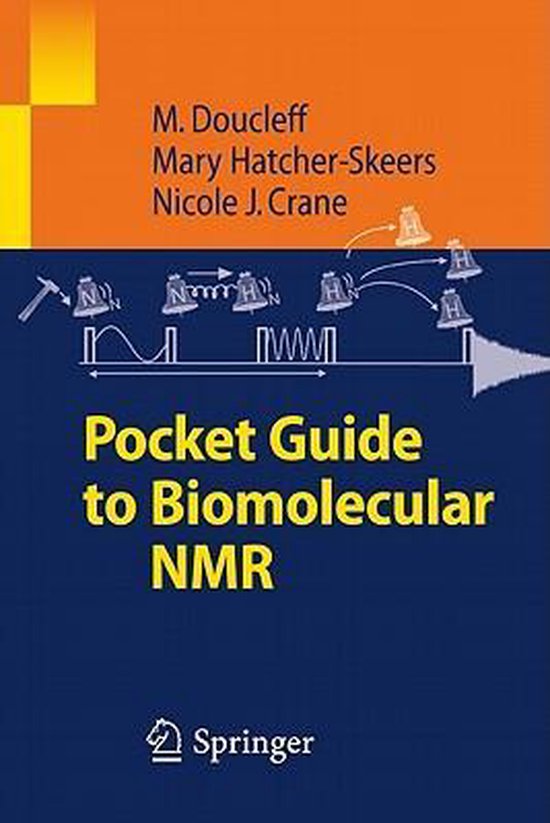
Steering clear of quantum mechanics and product operators, "Pocket Guide to Biomolecular NMR" uses intuitive, concrete analogies to explain the theory required to understand NMR studies on the structure and dynamics of biological macromolecules. For example, instead of explaining nuclear spin with angular momentum equations or Hamiltonians, the books describes nuclei as "bells" in a choir, ringing at specific frequencies depending on the atom type and their surrounding electromagnetic environment.This simple bell analogy, which is employed throughout the book, has never been used to explain NMR and makes it surprisingly easy to learn complex, bewildering NMR concepts, such as dipole-dipole coupling and CPMG pulse sequences. Other topics covered include the basics of multi-dimensional NMR, relaxation theory, and Model Free analysis. The small size and fast pace of “Pocket Guide to Biomolecular NMR” makes the book a perfect companion to traditional biophysics and biochemistry textbooks, but the book's unique perspective will provide even seasoned spectroscopists with new insights and handy “thought” short-cuts.
Steering clear of quantum mechanics and product operators, "Pocket Guide to Biomolecular NMR" uses intuitive, concrete analogies to explain the theory required to understand NMR studies on the structure and dynamics of biological macromolecules. For example, instead of explaining nuclear spin with angular momentum equations or Hamiltonians, the books describes nuclei as "bells" in a choir, ringing at specific frequencies depending on the atom type and their surrounding electromagnetic environment.This simple bell analogy, which is employed throughout the book, has never been used to explain NMR and makes it surprisingly easy to learn complex, bewildering NMR concepts, such as dipole-dipole coupling and CPMG pulse sequences. Other topics covered include the basics of multi-dimensional NMR, relaxation theory, and Model Free analysis. The small size and fast pace of “Pocket Guide to Biomolecular NMR” makes the book a perfect companion to traditional biophysics and biochemistry textbooks, but the book's unique perspective will provide even seasoned spectroscopists with new insights and handy “thought” short-cuts.