
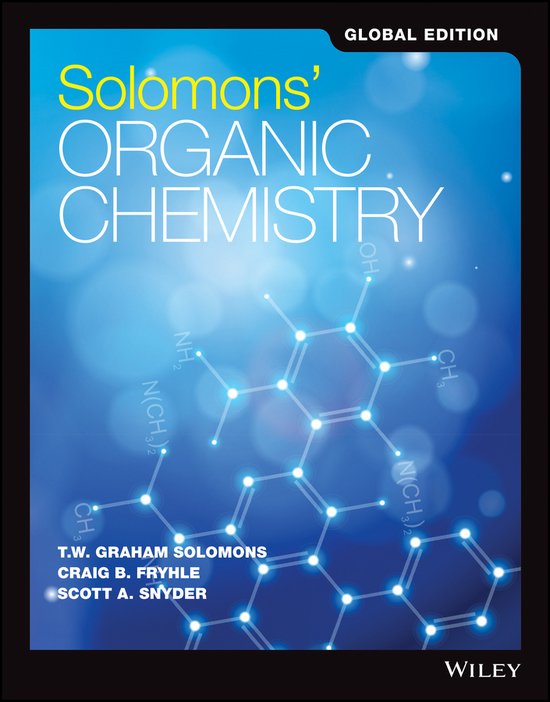
Solomons's Organic Chemistry
T. W. Graham Solomons
- 27 juni 2017
- 9781119248972
Samenvatting:
The 12th edition of Organic Chemistry continues Solomons, Fryhle & Snyder's tradition of excellence in teaching and preparing students for success in the organic classroom and beyond. A central theme of the authors' approach to organic chemistry is to emphasize the relationship between structure and reactivity.
Solomons' Organic Chemistry - Solomons, Fryhle & Synder's tradition of excellence in teaching and preparing students for success in the organic classroom and beyond is continued in Global Edition. The book makes it possible for students to learn organic chemistry well and to see the marvelous ways that organic chemistry touches our lives on a daily basis. Adding to on-going pedagogical strengths, here are a few new features:
- Improved presentation of the chemistry of benzene rings by streamlining and redistribution of content of chapter : Phenols and Aryl Halides
- New chapter on Transition Metal Organometallic Complexes
- Reorganized nucleophilic substitution and elimination topics
- Enhanced focus on the practicalities of spectroscopy
- Synthesizing the Material: new end of chapter problems
Table of Contents
- The Basics Bonding and Molecular Structure
- Families of Carbon Compounds Functional Groups, Intermolecular Forces, and Infrared (IR) Spectroscopy
- Acids and Bases An Introduction to Organic Reactions and Their Mechanisms
- Nomenclature and Conformations of Alkanes and Cycloalkanes
- Stereochemistry Chiral Molecules
- Nucleophilic Reactions Properties and Substitution Reactions of Alkyl Halides
- Alkenes and Alkynes I Properties and Synthesis. Elimination Reactions of Alkyl Halides
- Alkenes and Alkynes II Addition Reactions
- Nuclear Magnetic Resonance and Mass Spectrometry Tools for Structure Determination
- Radical Reactions
- Alcohols and Ethers Synthesis and Reactions
- Alcohols from Carbonyl Compounds Oxidation???Reduction and Organometallic Compounds
- Conjugated Unsaturated Systems
- Aromatic Compounds
- Reactions of Aromatic Compounds
- Aldehydes and Ketones Nucleophilic Addition to the Carbonyl Group
- Carboxylic Acids and Their Derivatives Nucleophilic Addition???Elimination at the Acyl Carbon
- Reactions at the ?? Carbon of Carbonyl Compounds Enols and Enolates
- Condensation and Conjugate Addition Reactions of Carbonyl Compounds More Chemistry of Enolates
- Amines
- Transition Metal Complexes Promoters of Key Bond-Forming Reactions
- Carbohydrates
- Lipids
- Amino Acids and Proteins
- Nucleic Acids and Protein Synthesis
- Answers to Selected Problems
- Glossary
- Photo Credits
- Index
New To This Edition
WileyPLUS is now equipped with an adaptive learning module called ORION. Based on cognitive science, WileyPLUS with ORION, provides students with a personal, adaptive learning experience so they can build their proficiency on topics and use their study time most effectively. WileyPLUS with ORION helps students learn by learning about them. WileyPLUS with ORION for Organic Chemistry 12e also features new conceptual practice exercises and support for students including
- Interactive concept map exercises
- Interactive summary of reactions exercises
- Interactive mechanism review exercises
- Video walkthroughs of key mechanisms by the authors
In response to market feedback, the authors have improved the current presentation of the chemistry of benzene rings by moving Ch 21, Phenols and Aryl Halides after Ch15, Reactions of Aromatic Compounds. Other 12e revisions include
- Synthesizing the Material: new end of chapter problems that requires the student to use synthesis methods across chapters
- New Transition Metal Chemistry chapter located after the Ch20, Chemistry of Amines
The Wiley Advantage
WileyPLUS is a research-based online environment for effective teaching and learning. WileyPLUS has robust interactive study tools and resourcesincluding the complete online textbookto give your students more value for their money. With WileyPLUS, students will be provided with unique study strategies, tools, and support based on learning styles for success in Organic Chemistry. WileyPLUS hallmarks, such as Reaction Explorer, remain alongside brand-new course updates.
Solomons' Organic Chemistry has a strong legacy (over 50 years) of tried and true content. The authors are known for striking a balance between the theory and practice of organic chemistry. In this new edition special attention is paid towards helping students learn how to put the various pieces of organic chemistry together in order to solve problems. The notion of a "puzzle", or understanding how different molecules react together to create products, is a focus of the authors’ pedagogy. A central theme of the authors' approach to organic chemistry is to emphasize the relationship between structure and reactivity. To accomplish this, the content is organized in a way that combines the most useful features of a functional group approach with one largely based on reaction mechanisms. The authors' philosophy is to emphasize mechanisms and their common aspects as often as possible, and at the same time, use the unifying features of functional groups as the basis for most chapters. The structural aspects of the authors' approach show students what organic chemistry is. Mechanistic aspects of their approach show students how it works.