
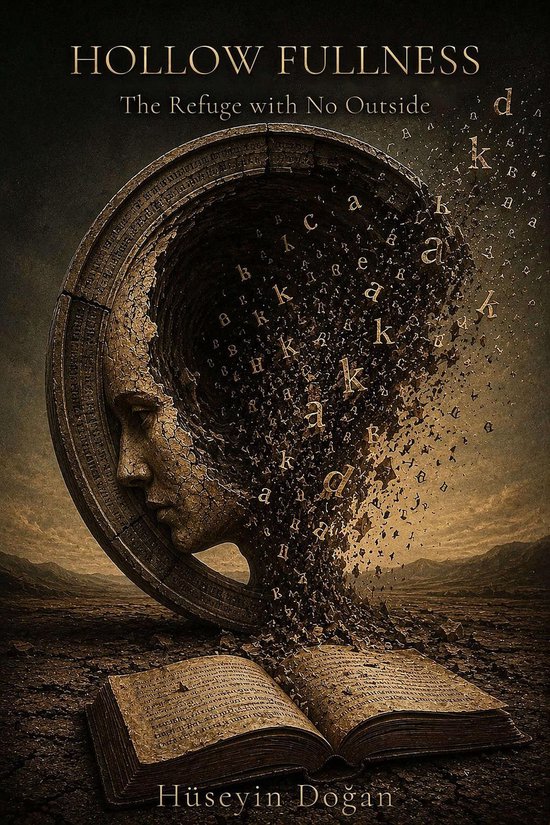
Hollow Fullness
Hüseyin Dogan
- 05 juli 2026
- 9789403913377
Samenvatting:
Man seeks the truth; if he does not find it, he makes a form and contents himself with that form. For truth hurts, the absurd reassures. He chooses the reassurance and calls it "the search for truth". But whoever reaches the truth is not satisfied: satisfaction is bound to form, and truth transcends form.
Truth exists, but no eye sees it. What no eye sees cannot be called existent; what is called non-existent is not non-existent. It is the only thing that neither exists nor does not exist. Man knows only existence or non-existence and cannot stand between them; therefore truth and man lie in different dimensions, without a bridge. In your dimension there is not the truth but its shadow - and he who takes the shadow for truth and he who knows it is a shadow see the same thing: the shadow.
Hollow Fullness sets out from a simple but unsettling proposition: the human mind is not made to find the truth, but to protect itself. The mind is not a court of law, but a refuge. Everything you believe in - your convictions, your certainties, your name, your identity - is a wall against the void. And a good refuge hides even the fact that it is one.
From this single premise the book draws its conclusions with merciless consistency. To see anything, you must turn to one side, and at that moment the other side darkens: the impartial one is blind, the partial one sees wrongly. Your thinking will not save you, for your reasons are born to justify, after the fact, what you have long since believed. Reason is as much a tool that finds the true as a shield that protects the untrue - which is why the cleverest err most firmly. And whoever flees into doubt discovers that doubt, too, is a belief: unbelief is the most hidden belief. There is no exit; every exit becomes a new entrance.
The holy books and philosophy are a catalogue of those shadows, not of the essential. But to call something a shadow is to say that there is something that casts it; the catalogue indirectly betrays the invisible. To point is not to reach - whoever points at the unreachable does not believe it can be reached, but that it exists.
This is not a book that consoles or promises answers. Each sentence sets up a proposition and undermines it from within; out of that refutation grows the next, in a spiral that never closes and never runs empty. It will not heal you - healing, too, is a wall. The only thing it can do is cast a small shadow on your own wall; then you see the shadow, then the wall, then that you are standing there by your own choice, if only for one second. It does not shout; it whispers to the solitary one who has never stopped asking.
In the end, Hollow Fullness asks precisely that of you: not to believe that you can reach the truth, but that the truth exists.