
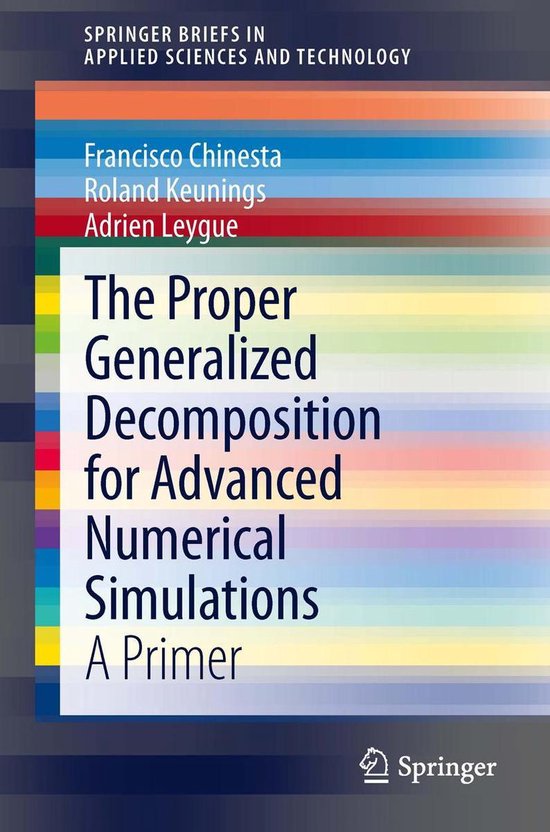
Engineering (R0) - The Proper Generalized Decomposition for ...
Francisco Chinesta
- 08 oktober 2013
- 9783319028651
Samenvatting:
Many problems in scientific computing are intractable with classical numerical techniques. These fail, for example, in the solution of high-dimensional models due to the exponential increase of the number of degrees of freedom.
Recently, the authors of this book and their collaborators have developed a novel technique, called Proper Generalized Decomposition (PGD) that has proven to be a significant step forward. The PGD builds by means of a successive enrichment strategy a numerical approximation of the unknown fields in a separated form. Although first introduced and successfully demonstrated in the context of high-dimensional problems, the PGD allows for a completely new approach for addressing more standard problems in science and engineering. Indeed, many challenging problems can be efficiently cast into a multi-dimensional framework, thus opening entirely new solution strategies in the PGD framework. For instance, the material parameters and boundary conditions appearing in a particular mathematical model can be regarded as extra-coordinates of the problem in addition to the usual coordinates such as space and time. In the PGD framework, this enriched model is solved only once to yield a parametric solution that includes all particular solutions for specific values of the parameters.
The PGD has now attracted the attention of a large number of research groups worldwide. The present text is the first available book describing the PGD. It provides a very readable and practical introduction that allows the reader to quickly grasp the main features of the method. Throughout the book, the PGD is applied to problems of increasing complexity, and the methodology is illustrated by means of carefully selected numerical examples. Moreover, the reader has free access to the Matlab© software used to generate these examples.