
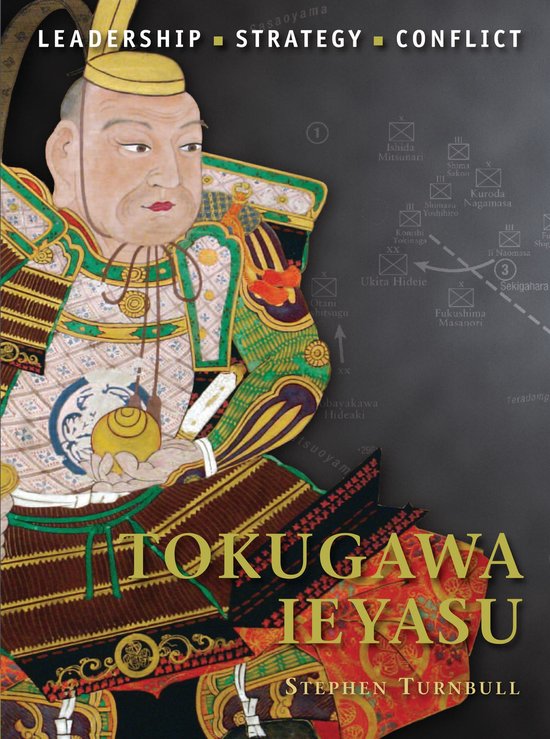
Tokugawa Ieyasu
Stephen Turnbull
- 20 juni 2012
- 9781780964447
Samenvatting:
Towards the end of the 16th century three outstanding commanders brought Japan's century of civil wars to an end, and even though reunification was first achieved under Toyotomi Hideyoshi, it was his successor Tokugawa Ieyasu who was to ensure a lasting peace.
In terms of his strategic and political achievements Ieyasu ranks as Japan's greatest samurai commander. His battlefield prowess, however, needs careful consideration before accolades are offered, because Ieyasu was undoubtedly a lucky general. Mikata ga Hara, for example, was a defeat that the onset of winter saved from being a rout.
Ieyasu's crowning victory at Sekigahara depended very much on the defection to his side of Kobayakawa Hideaki, and the absence from the scene of Ieyasu's son Hidetada serves to illustrate how just once there was a failure in Ieyasu's otherwise classic strategic vision. Yet Ieyasu possessed the particular wisdom of knowing who should be an ally and who was an enemy, and he was gifted in the broad brush strokes of a campaign. He also knew how to learn from his mistakes.
Ieyasu was also patient, a virtue sadly lacking in many of his contemporaries, and unlike Hideyoshi never outreached himself. To establish his family as the ruling clan in Japan for the next two and a half centuries was abundant proof of his true greatness.