
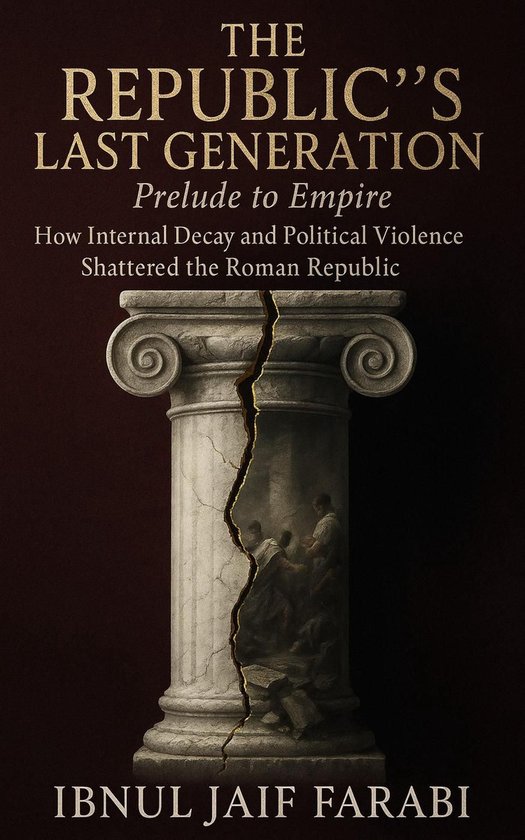
The Republic's Last Generation: Prelude to Empire
Ibnul Jaif Farabi
- 24 februari 2026
- 9798233709289
Samenvatting:
The Roman Republic did not collapse overnight. It eroded slowly, violently, and almost imperceptibly—until it was too late.
In The Republic's Last Generation: Prelude to Empire, Ibnul Jaif Farabi delivers a gripping work of narrative history that examines the fatal century that transformed Rome from republic to autocracy. This is the story of the fall of the Roman Republic told not as distant legend, but as a living political drama—one shaped by ambition, corruption, populist fury, and the steady normalization of political violence.
At its height, the Roman Republic governed vast territories with a complex system of checks and balances. But beneath the surface, cracks were forming. Economic inequality widened. Veterans returned from foreign wars to a city that could not sustain them. Political factions hardened. What followed was the crisis of the Republic—a spiral of unrest that would define the history of ancient Rome.
Farabi guides readers through the pivotal final generation, beginning with the Social War and moving through the brutal rivalry of the Sulla Marius civil war. You will witness how Lucius Cornelius Sulla marched his legions on Rome itself, establishing a terrifying precedent: that military power could overrule civic law. His proscriptions—state-sanctioned murder lists—reshaped Roman politics through fear.
From there, the Republic never fully recovered.
The narrative unfolds through the towering personalities who accelerated its demise. Gaius Marius, the reformer whose military innovations changed the loyalty of Rome's armies. Pompey the Great, whose ambition outpaced his judgment. Marcus Licinius Crassus, whose wealth masked dangerous political calculations. Cicero, struggling to defend constitutional order. And at the center of it all, Julius Caesar—whose biography cannot be separated from the Republic's final unraveling.
Farabi examines not just the battlefield clashes but the deeper machinery of political corruption history: rigged courts, bribed assemblies, manipulated elections, and street gangs that turned civic life into organized chaos. The Senate became paralyzed by factionalism. Reform became indistinguishable from revolution. Political rivals were no longer opponents—they were enemies to be eliminated.
Through vivid reconstruction and careful scholarship, this account of Roman history for adults places you inside the Senate house during explosive debates and on the streets where mobs enforced political will. You will see how institutional guardrails weakened step by step, how norms collapsed before laws did, and how repeated "temporary emergencies" justified permanent changes.
This is more than a history of ancient Rome. It is a case study in how republics fail.
The book explores how the concentration of military power, the erosion of trust in institutions, and the personalization of politics combined to make civil war inevitable. When Caesar crossed the Rubicon, it was not the beginning of the end—it was the logical outcome of decades of decay. The Republic's last generation did not merely witness its destruction; they participated in it.
Written with the pace of a political thriller and the clarity of a seasoned historian, Farabi transforms complex constitutional struggles into compelling human drama. Readers who appreciate deeply researched narrative history will find a character-driven account that makes familiar events feel urgent and unsettlingly relevant.
The fall of the Roman Republic remains one of history's most consequential turning points. From its ashes rose the Roman Empire, reshaping the ancient world for centuries to come. But to understand empire, we must first understand the republic that fractured.
If you have ever wondered how a powerful republic can destroy itself from within, this book offers a sobering, unforgettable answer.