
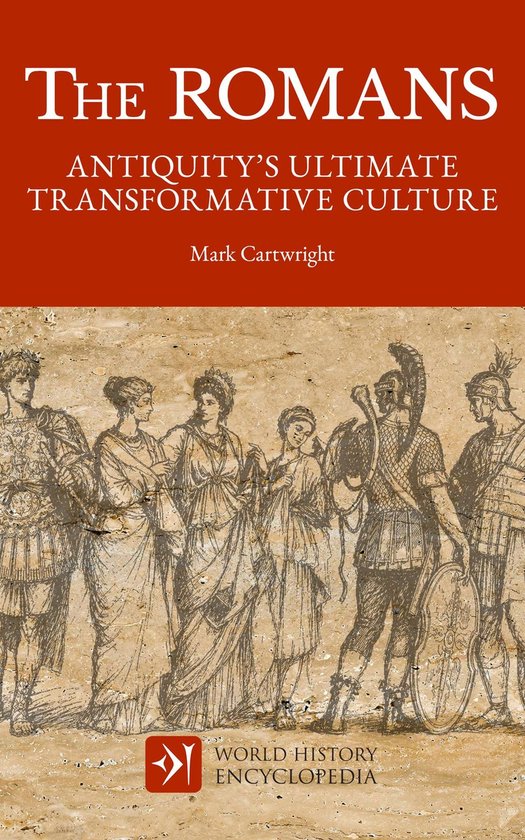
The Romans
Mark Cartwright
- 25 juni 2026
- 9798904179588
Samenvatting:
The Romans: Antiquity's Ultimate Transformative Culture examines nine different aspects of daily life for those who lived in what became the vast Roman Empire. The nine chapters all strive to answer a single question: What did it mean to be a Roman? It is a question with a multitude of answers.
We will discover what the Romans ate, what they wore, and who married whom. We will see what a Roman town looked like, what the religious practices entailed, how the state was governed, and what was on offer for people to forget their troubles and be royally entertained. We will also see how non-Romans lived within this empire and discover how the Romans saw themselves. Along the way, we will meet the achievements of the Romans, whether it be powerful catapults, concrete domes, enduring roads, evocative portraits, or advances in medicine.
Meet Antiquity's Ultimate Transformative Culture
- Warfare: Discover the secrets to the Roman army's success, the legions, tactics, siege engines, naval warfare, forts, and logistics, and imagine what a triumph must have looked like.
- Art and Architecture: Explore the Greek roots of Roman art and architecture and the new, distinctly Roman features that popped up in every city: public baths, aqueducts, amphitheatres, triumphal arches, and more. Marvel at the exquisite glasswork, colorful mosaics, and realistic sculptures the Romans left behind.
- Religion: Dive into the rich world of Roman mythology, from its foundation myths to its many cults, and follow the spread of Christianity.
- Science: Learn about innovative agricultural and building methods, advances in medicine, and developments in astrology and astronomy.
- Government and Society: Trace Rome's transformation from republic to empire and the social changes brought on by territorial expansion.
- Daily Life and Entertainment: Experience the bloody spectacles of the arena or enjoy the delights of a Roman dinner party.
Why This History Matters Today
Unlike many other ancient civilizations, such as those the legions conquered, the Roman Empire, which came to dominate the ancient Mediterranean and beyond, has left not vague and disputed traces but whopping great chunks of material culture. Likewise, the ideas of the Romans survive and can be seen in all manner of areas of daily life in the modern day. The Romans seem similar to us in so many ways because of those enduring aspects of culture that run through modern life, but they also seem to belong to another now lost world where norms of behavior were entirely different. Bridges of enquiry may be built to temporarily connect our world to theirs.
Featuring infographics and maps by World History Encyclopedia's in-house visual designer and cartographer Simeon Netchev, and an extensive bibliography, The Romans is an essential book about the enduring achievements of Roman culture for students, researchers, and history enthusiasts alike.