
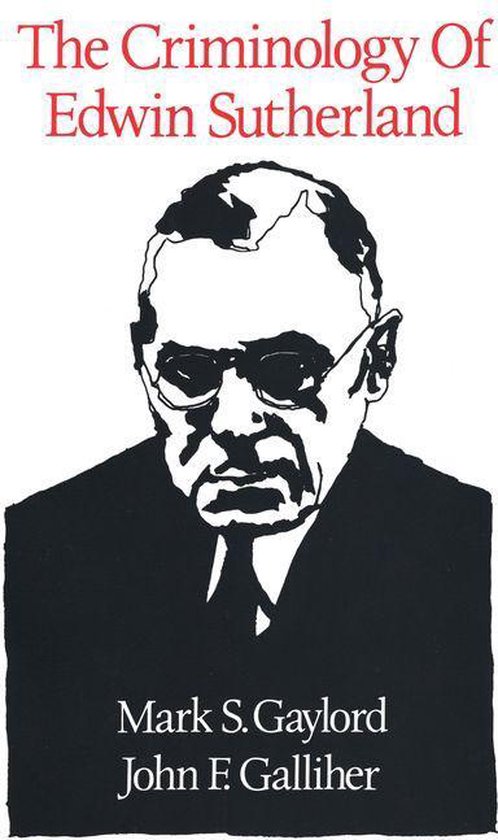
The Criminology of Edwin Sutherland
Mark S. Gaylord
- 14 oktober 2020
- 9781000679588
Samenvatting:
Edwin Sutherland is the acknowledged father of American criminology. This is the first full-length analysis of his work and his person. Unlike the European schools of criminology, which sought to locate deviant behaviour within the deep structures of the economy, Sutherland eschewed such explanations in favour of proximate and observable causes. He located the sources of crime in the association and interaction of specific groups of people. For Sutherland, crime as a way of life results from an individual's attachment to criminals for whom criminal acts are a measure of success no less than a way of life. In a series of publications, Sutherland expanded the horizons of the classic "Chicago School" of interactionists, and in the process founded criminology as a separate area of research while locating it firmly within sociology. As the authors show, Sutherland's work was inspired by strong moral concerns and a sense of the needs of society for social order without falling prey to either blaming the victim or pandering to sentiment about the joys of criminal life. In this sense, he is a model of the sociological tradition long deserving of the biography acknowledging his role as a master and pioneer. Yet Gaylord and Galliher have written more than an intellectual biography. They take seriously the need to fit Sutherland and his "theory of differential association" into a social and historical context. They are also aware and critically straightforward about the limitations of Sutherland's work in criminology, but place both his achievements and their limitations in a fully developed analytical context.