
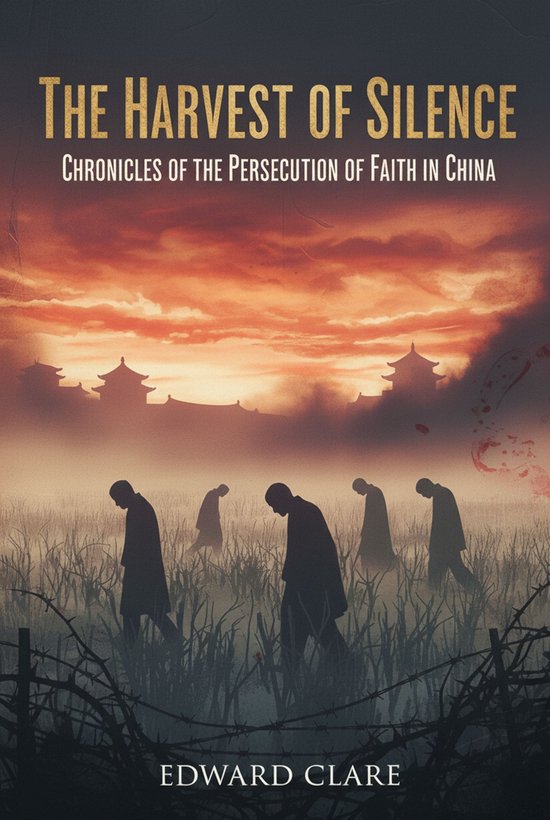
Harvest of Silence: Chronicles of the Persecution of Faith i ...
Edward Clare
- 21 januari 2026
- 9798232784362
Samenvatting:
Edward Clare's book *Harvest of Silence: Chronicles of the Persecution of Faith in China* is an in-depth investigation into brutal crimes against humanity occurring in the People's Republic of China. The narrative starts with the harrowing story of survivor Cheng Peimin, who woke up in a hospital after a forced organ harvesting and managed to escape, becoming the first documented witness to this death conveyor. His scar and testimony kick off a large-scale investigation into a system of terror directed at millions of peaceful citizens, whose only crime was their spiritual beliefs.
The book traces the origins of this tragedy back to the mid-1990s when Falun Gong practitioners engaged in peaceful morning meditations in Beijing parks, following the principles of Truthfulness-Compassion-Forbearance. This movement sparked a spiritual awakening in a nation still reeling from the Cultural Revolution. Clare details the significant April 1999 appeal near the Zhongnanhai government complex, where tens of thousands peacefully called for the release of arrested fellow believers, demonstrating remarkable self-discipline and the nonviolent character of the movement.
However, the CCP leadership, led by Jiang Zemin, viewed this mass movement as a threat to its ideological control. In July 1999, a total suppression mechanism was unleashed, starting with the extrajudicial "Office 610," empowered to eradicate Falun Gong by any means necessary. Clare lays out a three-part strategy of discrediting, bankrupting, and physically destroying the practitioners, highlighting how victims were stigmatized and dehumanized through state media. This culminated in the 2001 self-immolation incident at Tiananmen Square, strategically orchestrated to present practitioners as dangerous fanatics.
The book discusses the role of the Chinese Anti-Cult Association, a pseudoscientific body created to give a facade of legitimacy to the genocide, and its international cooperation with anti-cult organizations in Russia and Europe, establishing a global persecution network. Clare's investigation analyzes the forced organ harvesting industry, drawing on the work of David Kilgour, David Matas, and the independent China Tribunal, which has proved the existence of a centralized system turning prisoners of conscience into living organ banks.
Personal stories of victims, including engineers and scientists tortured in re-education camps, illustrate the horrifying reality. One such victim, engineer Lu Kaili, spent thirteen and a half years in prison and was left disabled with multiple spinal fractures.
Clare also shows how the methodology of repression applied to Falun Gong members was extended to the Church of Almighty God, with similar medical examinations and torture faced by its members. Statistics indicate that hundreds of thousands have been arrested, and the official transplant numbers starkly diverge from actual organ availability, hinting at a hidden organ source.
This issue transcends local human rights concerns; it poses a global threat as the Chinese model of dissent suppression is exported to other countries, criminalizing faith and making conscience a capital offense. The ongoing "harvest of silence" is perpetuated by a world that prioritizes economic gain over human rights protection. Clare's book serves not only as a record of horror but also an indictment of indifference, showcasing the indomitable spirit of humanity against absolute evil.