
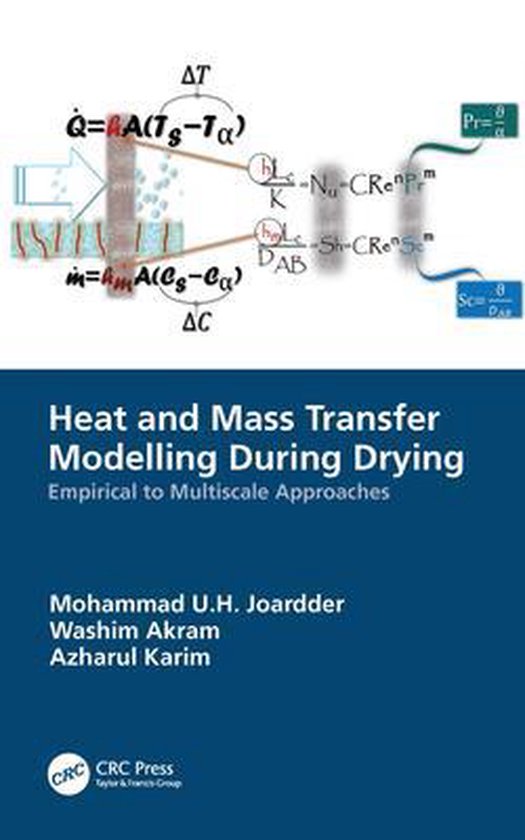
Heat and Mass Transfer Modelling During Drying
Mohammad U.H. Joardder
- 30 september 2021
- 9780429865527
Samenvatting:
Most conventional dryers use random heating to dry diverse materials without considering their thermal sensitivity and energy requirements for drying. Eventually, excess energy consumption is necessary to attain a low-quality dried product. Proper heat and mass transfer modelling prior to designing a drying system for selected food materials can overcome these problems. Heat and Mass Transfer Modelling During Drying: Empirical to Multiscale Approaches extensively discusses the issue of predicting energy consumption in terms of heat and mass transfer simulation.
A comprehensive mathematical model can help provide proper insight into the underlying transport phenomena within the materials during drying. However, drying of porous materials such as food is one of the most complex problems in the engineering field that is also multiscale in nature. From the modelling perspective, heat and mass transfer phenomena can be predicted using empirical to multiscale modelling. However, multiscale simulation methods can provide a comprehensive understanding of the physics of drying food materials.
KEY FEATURES
- Includes a detailed discussion on material properties that are relevant for drying phenomena
- Presents an in-depth discussion on the underlying physics of drying using conceptual visual content
- Provides appropriate formulation of mathematical modelling from empirical to multiscale approaches
- Offers numerical solution approaches to mathematical models
- Presents possible challenges of different modelling strategies and potential solutions
The objective of this book is to discuss the implementation of different modelling techniques ranging from empirical to multiscale in order to understand heat and mass transfer phenomena that take place during drying of porous materials including foods, pharmaceutical products, paper, leather materials, and more.