
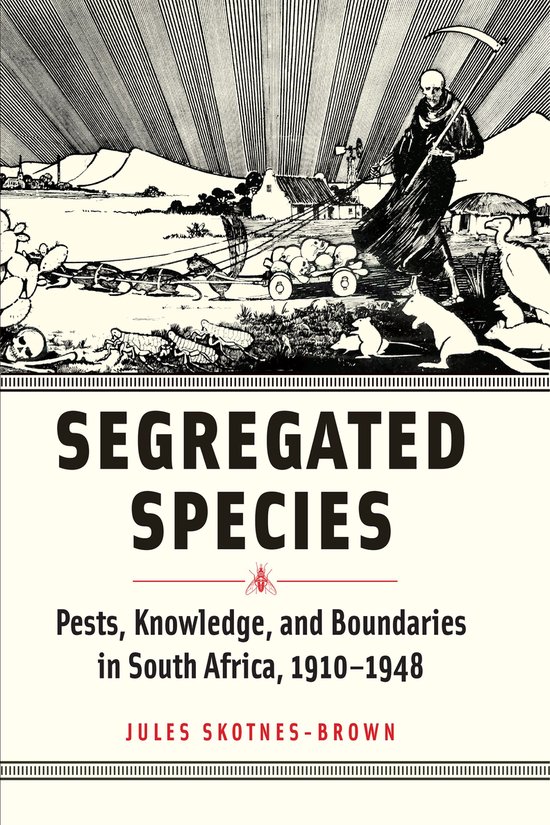
Animals, History, Culture - Segregated Species
Jules Skotnes-Brown
- 30 juli 2024
- 9781421448572
Samenvatting:
A timely history of the connections between science, segregation, and species in twentieth-century South Africa.
Winner of the First Book Prize by the Royal Historical Society
Throughout the twentieth century, rural South Africa was dominated by systems of racial segregation and apartheid that brutally oppressed its Black population. At the same time, the countryside was defined by a related settler obsession: the control of animals that farmers, scientists, and state officials considered pests. Elephants rampaged on farmlands, trampling fences, crops, and occasionally humans. Grain-eating birds flocked on plantations, devouring harvests. Bubonic plague crept across the veld in the bodies of burrowing and crop-devouring rodents.
In Segregated Species, Jules Skotnes-Brown argues that racial segregation and pest control were closely connected in early twentieth-century South Africa. Strategies for the containment of pests were redeployed for the management of humans and vice versa. Settlers blamed racialized populations for the abundance of pests and mobilized metaphors of pestilence to dehumanize them. Even knowledge produced about pests was segregated into the binary categories of "native" and "scientific." Black South Africans critiqued such injustices, and some circulated revolutionary rhetoric through images and metaphors of locusts.
Ultimately, pest-control practices played an important role in shaping colonial hierarchies of race and species and in mediating relationships among human groups. Skotnes-Brown demonstrates that the history of South Africa—and colonial history generally—cannot be fully understood without analyzing the treatment of both animals and humans.