
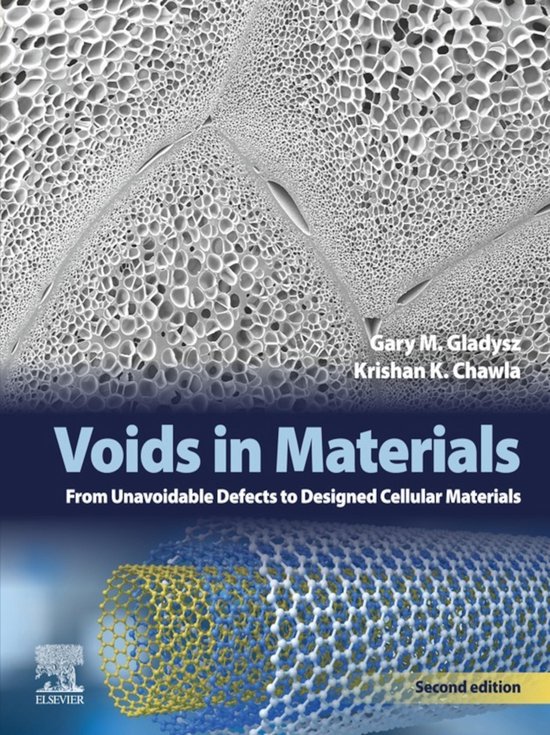
Voids in Materials
Gary M. Gladysz
- 30 november 2020
- 9780128192832
Samenvatting:
All materials have voids in them, at some scale. Sometimes the voids are ignored, sometimes they are taken into account, and other times they are the focal point of the research. Voids in Materials: From Unavoidable Defects to Designed Cellular Materials takes due notice of all these occurrences, whether designed or unavoidable defects. We define, categorize, and characterize the voids (or empty spaces in materials) and we analyze the effects they have on material properties. This second edition is an updated and expanded central reference for voids in materials and covers all types of voids, intrinsic and intentional, and stochastic and nonstochastic, and the processes and conditions that are needed to create them and is a valuable resource to students in the areas of mechanical engineering, chemical engineering, materials science and engineering, physics, and chemistry, as well as scientists, researchers, and engineers in industry. - the effect of voids in materials; from low volume fraction defects and free volume in polymer networks to high void volume fraction foams and aerogels - how and why voids are introduced into materials across the length scales - biomaterial design used in vivo for soft, hard, and nerve tissue scaffolds - metallic and geopolymeric foams - additive manufacturing technologies used to tailor regularity (R) in the cell structure - stochastic, nonstochastic, and Voronoi foams - the latest techniques for characterizing voids - new chapters, covering the Kirkendall effect to create hollow and porous structures, and nanometer scale voids: nanotubes, zeolites, organic frameworks, and nanoporous noble metals