
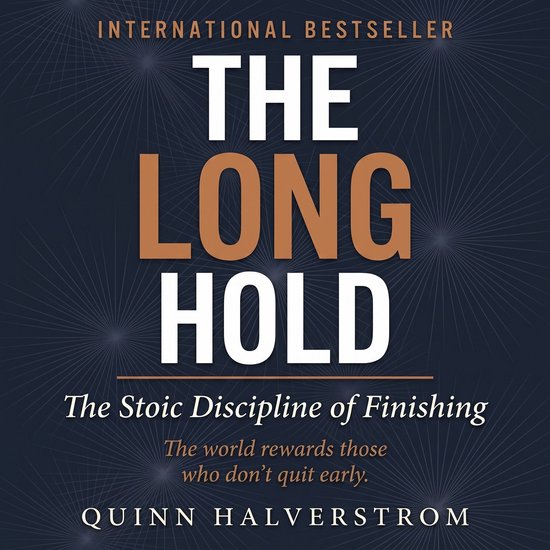
The Long Hold
- AuteurQuinn Halverstrom
- Uitgever
- Jaar2019
Most people do not fail because they lack talent. They fail because they stop too soon. In The Long Hold, philosopher Quinn Halverstrom draws on two decades of studying Stoic thought and working with executives, entrepreneurs, and practitioners to answer the question that matters most in any serious pursuit: how do you keep going when the excitement is gone, progress has stalled, and every reasonable part of you wants to quit?
Halverstrom dismantles the talent myth from the first page. Using K. Anders Ericsson's research on deliberate practice, Angela Duckworth's work on grit, and the Stoic discipline of Marcus Aurelius and Epictetus, he builds a rigorous, practical framework for finishing hard things over long periods of time. The verdict is both liberating and demanding: mastery is far more accessible than the gifted-few mythology suggests, but only to those willing to do the unglamorous, structured, sustained work that most people abandon before the results compound.
The Long Hold moves through the full architecture of long-term persistence. It explains how genuine interest is cultivated rather than discovered, how a passing curiosity becomes a durable calling, and how deliberate practice differs from mere repetition. It shows how routines serve as the bridge between intention and action, why hope is a cognitive skill that can be trained, and how the stories people tell themselves about failure either enable recovery or guarantee retreat. It examines the social infrastructure of persistence: the coaches, mentors, and cultures that make hard work feel normal, and the peer environments that quietly raise or lower every standard we hold.
Critically, The Long Hold also makes the case for quitting — not as failure, but as judgment. A chapter on strategic disengagement argues that grit without discernment becomes stubbornness, and that knowing when to stop is itself a form of discipline. The book does not ask readers to persist at everything. It asks them to persist at the right things, and to think clearly about the difference.
Through historical examples — Benjamin Franklin's self-designed writing practice, Thomas Edison's relentless experimentation, Abraham Lincoln's pattern of recovery after defeat, and late-life achievers like Grandma Moses and Colonel Sanders — Halverstrom shows what long-arc commitment looks like in practice. These are not stories of linear triumph. They are portraits of people who kept returning to the work after the novelty had faded, the early wins had stopped, and no guarantee of outcome existed.
The final chapters synthesize the book's themes into a design for a long-arc life: one built not through dramatic breakthroughs but through compounding — the quiet accumulation of deliberate effort, renewed purpose, and the repeated daily choice to begin again. Drawing on Marcus Aurelius's reminder to get up and do one's work "as a human being," Halverstrom reframes patience not as passive waiting but as the hardest and most productive form of action available.
For readers of Ryan Holiday, Robin Sharma, and Angela Duckworth, The Long Hold is a dense, serious, and ultimately hopeful book about one of the most important questions a person can face: what does it take to finish something that genuinely matters?

Meer van Quinn Halverstrom
 Luisterboek
A Clear Head
 Ebook
Ebook



0 REACTIES
Nog geen reacties.